NIS2 and DORA do not apply to a supplier in Islamabad or Doha. Their requirements arrive anyway, through the contract, and usually with a deadline attached. What to prepare before the clause appears.
Azhar Ghafoor17 November 20266 min read
A supplier in Islamabad or Doha reads that European cyber regulation does not apply outside the European Union, concludes it is somebody else's problem, and is technically correct.
Then a customer sends a contract amendment with incident notification windows measured in hours, an audit right, a subcontractor disclosure requirement and an exit plan obligation. Nobody has asserted that the regulation applies to you. Your customer is obliged to impose these terms on the people they depend on, so the requirement arrives commercially rather than legally.
That is how this reaches you, and the deadline is theirs rather than yours, which means you find out late.
What the two regimes actually ask of your customer
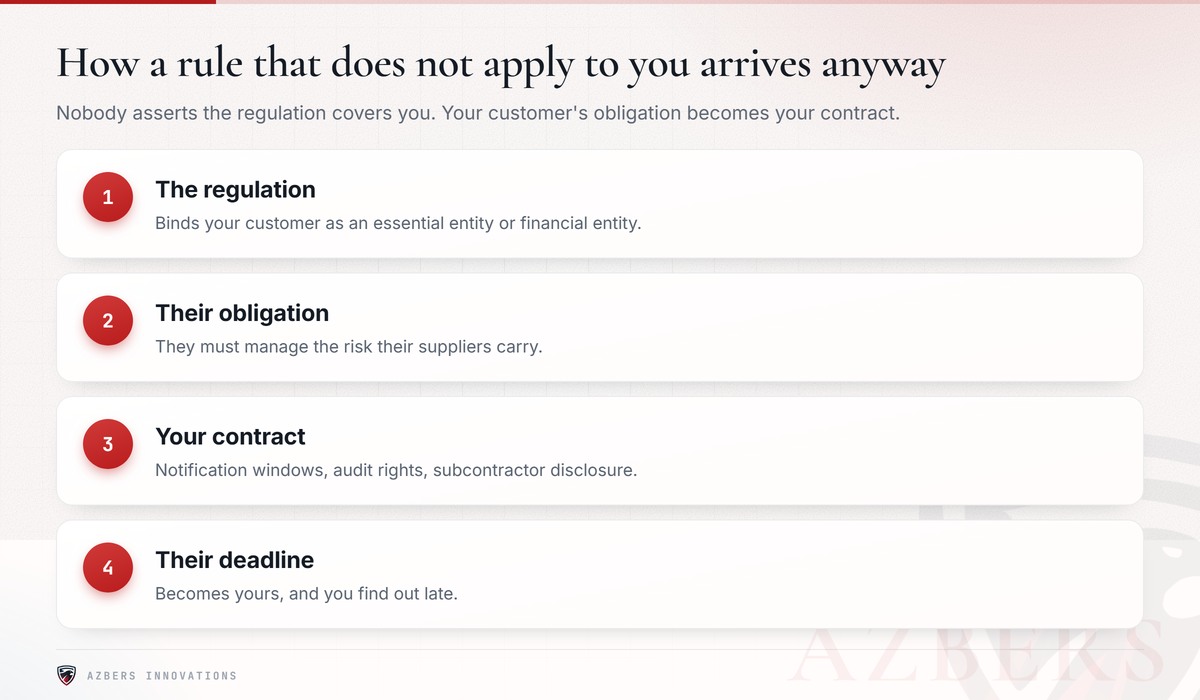
The regulation binds your customer, their obligation becomes your contract, and their deadline becomes yours.
NIS2 covers essential and important entities across sectors including energy, transport, health, digital infrastructure and public administration. It requires risk management measures, incident reporting on tight timelines, and explicitly requires supply chain security to be addressed.
DORA covers financial entities and is more prescriptive. It sets detailed expectations for managing information and communication technology third party risk, including a register of contractual arrangements, specified contract provisions, and stronger requirements where a provider supports a critical or important function.
Read together, both make your customer accountable for you. Which is why the clause arrives.
No regulator will contact you. Your customer's obligation becomes your contract, and their deadline becomes your deadline.
The clauses to expect
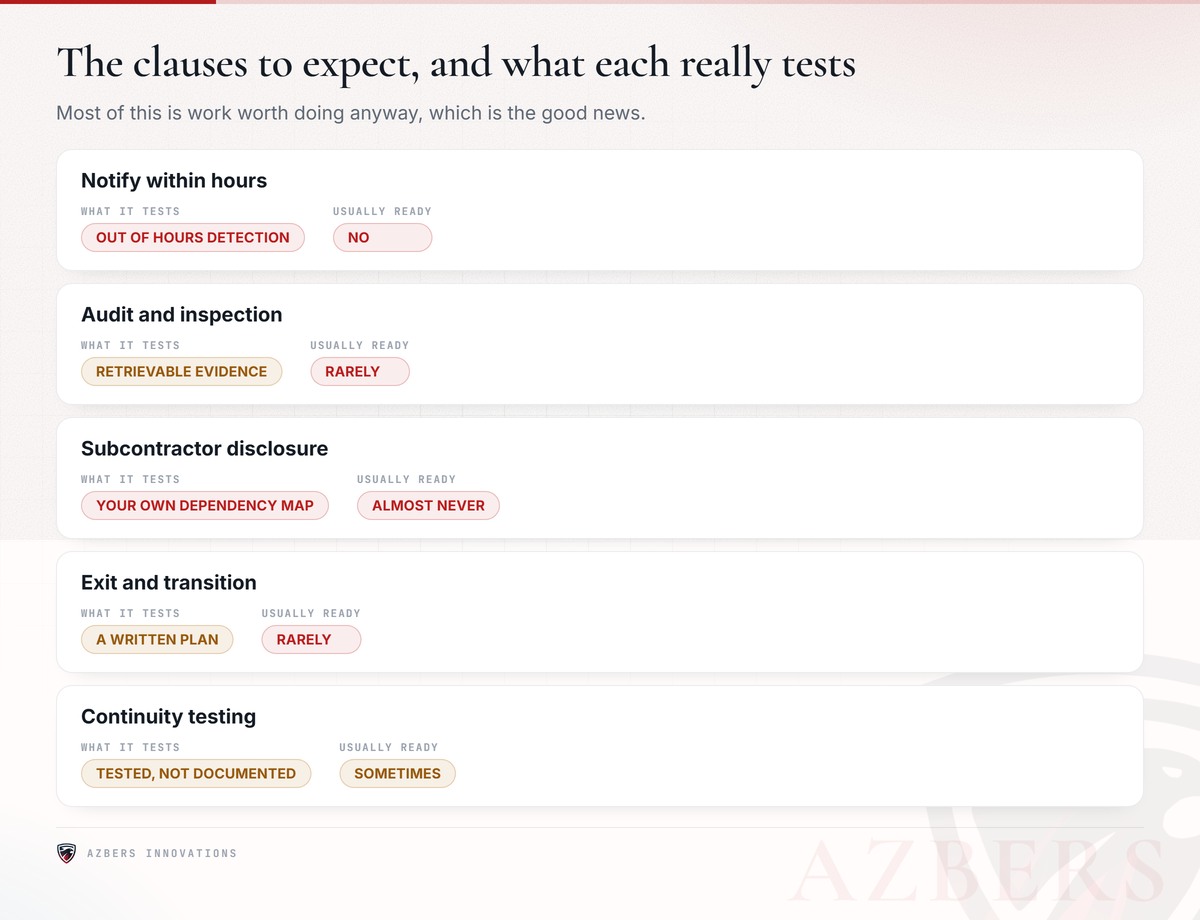
Each clause tests something specific, and most suppliers are not ready for the dependency map question.
Incident notification, in hours not days. Often within twenty four hours of becoming aware, with a fuller report later. This is the clause most suppliers accept without checking whether they can actually meet it, and the answer usually depends on whether anyone is watching outside working hours.
Audit and inspection rights. For the customer and sometimes their regulator, including on site. Small suppliers often find this the most uncomfortable clause and it is increasingly non negotiable.
Subcontractor disclosure and approval. You must say who you depend on and give notice before changing them. If you have never listed your own critical dependencies, this takes longer than you expect.
Exit and transition support. A documented plan for handing the service back, in a usable format, within a defined period. This is a real operational commitment rather than a formality.
Service continuity and testing evidence. Recovery objectives with evidence they have been tested rather than documented.
Security measures with proof. Named controls, and evidence they operate. Which is the same evidence problem we described in what a regulator actually wants to see.
What to prepare before it arrives
Almost all of this is work you should have done anyway, which is the good news.
Know your own dependencies. A list of the providers your service relies on, what would break without each, and what your alternative is. You will need it for the disclosure clause and it is the thing most suppliers have never written down. It is also the concentration problem from infrastructure fails in chains, seen from inside.
Be able to detect an incident within the window. A notification obligation measured in hours is a monitoring requirement wearing a legal costume. If nobody is watching overnight, you cannot meet it, and signing anyway converts a security gap into a contractual breach. The practical route is in a SOC in six months.
Write the notification path. Who decides an event is notifiable, who contacts the customer, through which channel, and what the first message contains. Decide this now, because the twenty four hour version of this decision is made badly.
Keep evidence as you go. Audit rights are survivable when your evidence is attached to controls and retrievable. They are brutal when evidence lives in individual inboxes and shared drives.
Have an exit plan. Format, timeline, and what assistance you provide. Writing it takes a day and refusing the clause without one costs you the contract.
The opportunity most suppliers miss
There is a commercial reading of this that gets overlooked.
Your customers are now obliged to assess their suppliers, and most of your competitors are answering these clauses slowly, defensively, and with visible improvisation. A supplier who can produce a dependency list, a notification procedure, tested recovery evidence and an exit plan on request is not merely compliant. They are conspicuously easier to buy from at the exact moment procurement has been told to look harder.
We have watched small suppliers win work against larger ones on precisely this, because the larger supplier could not answer the subcontractor question inside a fortnight.
Where we stand
We think suppliers outside Europe should treat this as one piece of work rather than as a European compliance project.
The measures NIS2 and DORA push down through contracts overlap heavily with ISO 27001, with national frameworks including PISF, and with the Qatari framework our ComplianceVault work covers. Building a separate programme per regime is how a small team loses a year.
State the control once, evidence it once, and let it answer every obligation that asks for it. That is the entire reason ControlGraph exists, and this is the case it was built for. CyberNexus holds the evidence and the named acceptance behind each control, which is what makes an audit right a retrieval exercise rather than a crisis.
Our GRC practice maps incoming contractual obligations against what you already run, so the gap you close is the real one rather than the whole clause.
Start here
Take your largest European customer contract and find the incident notification clause.
Then ask whether you would detect a relevant incident inside that window on a Saturday night. If the honest answer is no, you have a live contractual exposure today, and it is better to know.
Common questions
Does NIS2 apply to companies outside the EU
Not directly in most cases. It applies to your customer, who is required to manage supply chain risk, so the requirements reach you through contract terms rather than through regulation.
What is the difference between NIS2 and DORA
NIS2 is a broad directive covering essential and important entities across many sectors. DORA is a regulation specific to financial entities and is considerably more prescriptive about managing technology third party risk.
What contract clauses should suppliers expect
Incident notification within hours, audit and inspection rights, subcontractor disclosure and change approval, exit and transition support, service continuity testing evidence, and named security measures with proof they operate.
How quickly must incidents be reported
Customer obligations commonly translate into supplier notification windows of around twenty four hours from awareness, with fuller reporting later. Confirm the exact wording in each contract, since it varies.
Do we need a separate compliance programme for this
Usually not. The measures overlap substantially with ISO 27001 and with national frameworks. Mapping one set of controls to every obligation that asks for it is far more efficient than running parallel programmes.