
What we tell people who ask whether AI belongs in compliance work
The honest answer is that it belongs in the reading and nowhere near the deciding. Here is where we draw that line and why we draw it there.
Read the articleEvery organisation in a dependency chain can be individually compliant while the chain as a whole is assured by nobody. That gap is where national scale outages actually come from.
There is a particular kind of incident report that has become very common, and it always reads the same way. A service that millions of people depend on stops working. The organisation that runs it did nothing wrong. Its own systems were healthy, its own controls were in place, and its own last assessment came back clean.
The failure came from four steps upstream, in a company most of the affected users have never heard of, which in turn depended on something further upstream again.
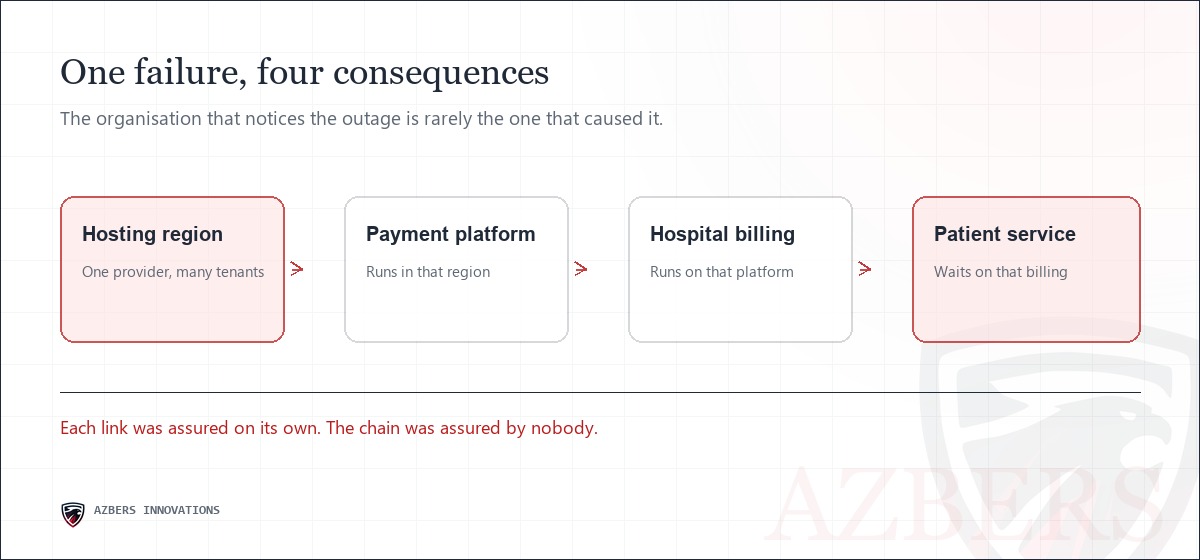
Everybody in that chain was individually compliant. The chain itself had no owner.
Compliance frameworks are written for organisations. That is entirely reasonable, since an organisation is the thing that can be held accountable, audited and fined. But it produces a specific blind spot, because the scope of every assessment ends exactly where the legal entity ends.
What sits beyond that boundary gets handled by a different mechanism, usually a supplier questionnaire or a contractual clause. Both are weak substitutes for assurance. A questionnaire tells you what a supplier was willing to assert about itself at a point in time, filled in by somebody in their sales organisation who was asked to complete it quickly. A contract tells you who is liable afterwards, which is a legal comfort rather than an operational one.
Neither one tells you what happens on Friday if that supplier is unavailable, and neither one knows what your supplier's supplier does.
The more interesting problem is not any single dependency. It is the way dependencies converge without anyone noticing.
Consider a sector regulator looking at twenty organisations. Each one submits its own posture. Each submission looks reasonable. What the regulator cannot see from those twenty documents is that fourteen of them run their most critical workload in the same hosting region, and eleven of them use the same authentication provider.
No individual organisation has made a bad decision. Each one chose a reputable provider for sound reasons. But the sector has quietly arranged itself into a shape where a single provider failure takes down most of it simultaneously, and that shape is invisible to every participant, including the regulator, because nobody is looking at the connections.
Concentration risk is not created by any one decision. It is created by many reasonable decisions that nobody compared.
Making this visible does not require new obligations on anyone. It requires that the information already being collected is collected in a shape that can be compared.
Three things have to be true.
Every part of the above could, in principle, be done by hand. Analysts could read twenty submissions, build a dependency map, and identify the concentration. Some sector bodies genuinely do this, and it takes them months, which means the map is already out of date when it is finished.
The reason to build this into a system is not novelty. It is that a map maintained by hand decays faster than it can be produced, and a map that reflects last year's architecture is worse than useless because it inspires confidence it has not earned.
That is the reasoning behind ControlGraph. The same structure that lets a control answer several frameworks at once is the structure that lets you ask what a single system failure would reach. Those look like two different products until you notice they are both traversals of the same graph.
We describe what we are building as work toward infrastructure that is safer, more compliant and more resilient. The third word in that list is the one that depends on the connections.
An organisation can be made safer on its own. It can be made compliant on its own. It cannot be made resilient on its own, because resilience is a property of the chain rather than of any link in it. Any serious attempt at national resilience has to be able to see across organisational boundaries, and right now very little of our assurance machinery is built to do that.
If you sit inside a sector where everyone quietly depends on the same few providers, that is exactly the problem we would like to hear about.
It is what happens when many organisations independently choose the same provider for good reasons, and the sector quietly arranges itself so that one provider failure takes down most of it at once. No single participant made a bad decision, which is exactly why nobody sees it.
They tell you what a supplier was willing to assert on a particular day, usually completed at speed by somebody under deadline pressure. They do not tell you what happens on the Tuesday their platform is unavailable, which is the question that actually matters.
Further than most programmes do. Third party risk work commonly stops at the direct supplier, and the failures that cause national scale outages usually originate one or two steps beyond that.
Legally, each organisation for its own part. Practically, nobody for the chain as a whole, which is the gap. Making it visible needs submissions that share a structure and dependencies recorded as relationships that can be traversed rather than sentences in an annex.
The honest answer is that it belongs in the reading and nowhere near the deciding. Here is where we draw that line and why we draw it there.
Read the article
They are not competing standards and you are not really choosing between them. One is a certifiable management system, the other is a way of describing where you stand. Here is how to tell which you need first.
Read the article
The phrase is used to sell dashboards. What it really describes is a change in when evidence is produced, and that change is the only part that matters.
Read the articleIf this raises a question about your own compliance position or your security operations, the quickest route is a direct conversation.