Every crosswalk is private
Each organisation builds its own mapping between frameworks in a spreadsheet, and nobody outside it can check the reasoning behind a single line.
ControlGraph holds the frameworks an organisation answers to, their controls, and every approved relationship between them as one governed map. When PISF, ISO 27001 and a sector rule ask for the same thing, you do the work once and see everywhere it counts, with the source and the approver of every link on record.
 AzbersInnovations
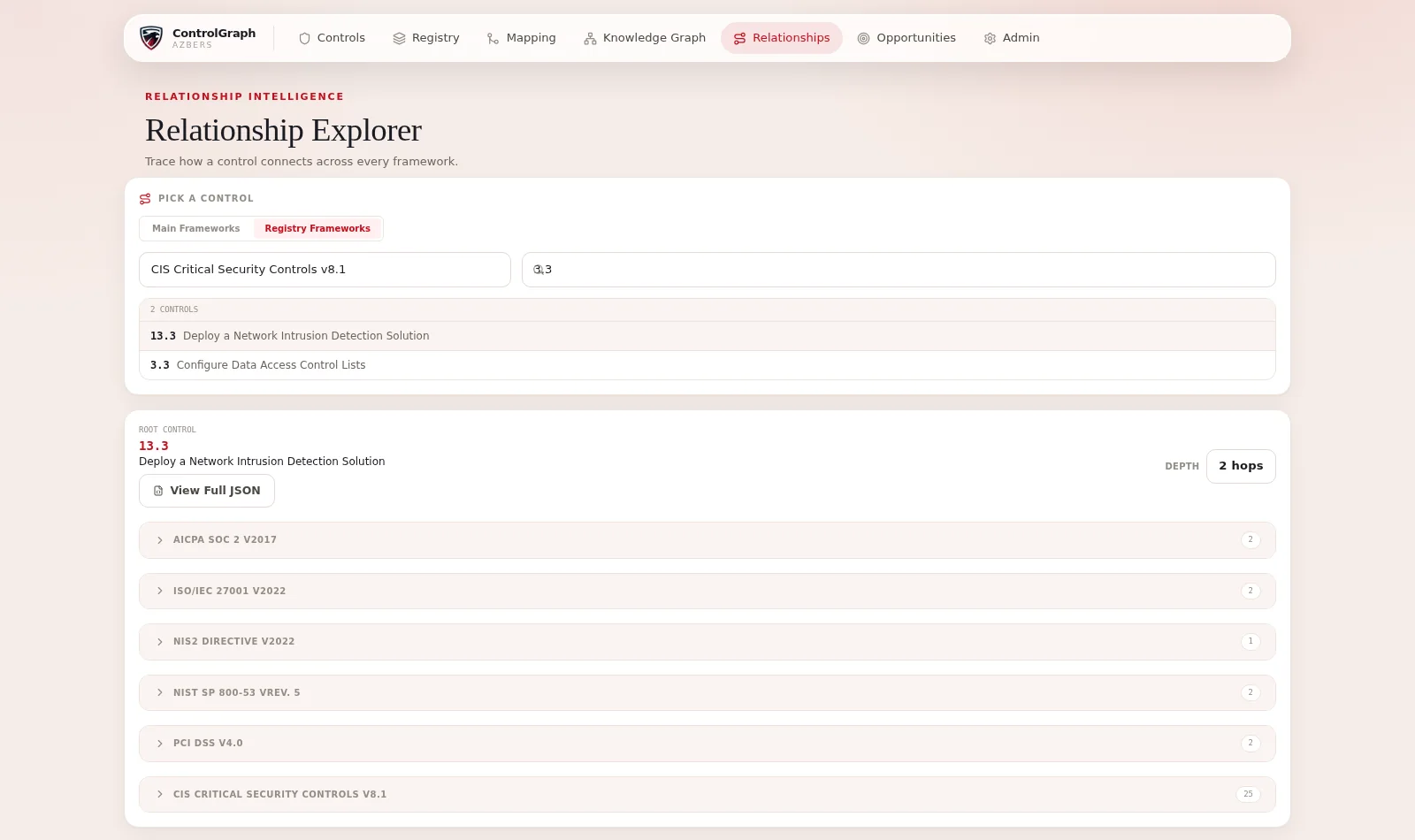
The question every auditor asks, answered on one screen. What else does this control satisfy? Screen from the ControlGraph demonstration environment.
In the catalogue of the demonstration environment
A bank or an operator now answers to PISF, to its sector regulator and to the international standards its partners ask for. Most of the underlying controls are the same. Proving that is still done again for every framework, by every organisation, on its own.
Each organisation builds its own mapping between frameworks in a spreadsheet, and nobody outside it can check the reasoning behind a single line.
The same PISF control can be mapped to ISO 27001 differently by two capable people, and there is no shared reference to settle which of them is right.
When a framework is revised, nobody knows which mappings moved, so last year's crosswalk quietly stops being true while everyone keeps relying on it.
The order matters. Nothing reaches a coverage figure until it has an identity, a source and a person who approved it.
National, international, sector or one you wrote yourself.
Each standard and version exists once, so everyone maps to the same thing.
Where a publisher ships its own mapping, it comes in exactly as published.
It proposes the relationships nobody has published yet.
Approve, approve as partial or reject. Pending counts for nothing.
Built only from approved relationships, with the working shown.
The directory is where a programme lead starts. The method is what an auditor asks about. Both are open to the people who have to rely on them.
The directory holds the reference text of each control with its area, criticality, risk level and business impact, next to how many approved relationships it already carries. The filters answer the first questions a programme lead asks, such as which critical controls are still unmapped.
 AzbersInnovations
Relationships use the relation types NIST published for exactly this job. Only approved, direct relationships count toward coverage, and every result names the version of the method that produced it, so the same figure can be reproduced a year later.
| Relation | What it means | Toward coverage |
|---|---|---|
| equal | The same requirement in different words | Counts in full |
| superset | The source fully contains the target | Counts in full |
| subset | The target asks for more than the source | Counts in part |
| intersects | The two overlap without either containing the other | Counts in part |
| related | Useful context, not a match | Does not count |
AzbersInnovationsA map is only worth building if it answers something on a working day. These are the questions we built it around.
Pick any control and follow it through every framework it touches, with each link marked as official or as an approved AI proposal.
Upload a policy once and see which controls it covers, partly covers or misses, framework by framework.
See which controls carry across the most frameworks, so one piece of work covers the most ground.
When a framework is revised, the mappings it affects are flagged for everyone who relies on them.
Reading two frameworks side by side and finding where they meet is slow work, and a machine does a good first pass at it. It is also exactly the kind of judgement nobody should take on trust, so the rules below hold whichever AI provider is in use.
AI suggests how a control relates to one in another framework.
Until someone approves it, it changes nobody's coverage.
Shared mappings by the national operator. An organisation's own need two approvers in two roles.
Running the AI again never overwrites an approved relationship.
There is no open chat box. Every AI feature is a fixed task whose output is checked before anyone sees it.
Official crosswalks always take precedence over anything the AI proposes.
Models can be hosted inside Pakistan, so control text and policies never need to leave the country.
NIST runs a national programme for exactly this, publishing reviewed mappings to its own frameworks. We think Pakistan should own the equivalent for PISF, and decide for itself how its framework relates to the rest of the world.
| Who | What changes for them |
|---|---|
| The national operator | Ownership of the official PISF crosswalk, the method behind it and every approval |
| Sector regulators | A clear view of where their rules already overlap PISF, so duplicate requests can be retired |
| Ministries and public bodies | Policies tested against PISF, and one piece of work recognised several times |
| Banks and operators | PISF, their sector rules, ISO 27001 and PCI DSS connected in one place |
| Auditors | A shared reference with the source and the approver of every mapping |
CyberNexus keeps the assessment, the evidence and the Authority's verification. ControlGraph keeps the frameworks, the relationships and the coverage calculation. When an organisation finalises a PISF cycle, the results can travel across signed, and ControlGraph uses the Authority's verified score wherever one exists. Anything tampered with or replayed on the way is refused.
The questions that come up most often, answered the way we would answer them on a call.
A spreadsheet records that someone believed two controls match. ControlGraph records the relation type, where it came from, who approved it and when, and it recalculates coverage from approved relationships only. You can check the reasoning behind any number it shows.
It proposes, and a person approves. A proposal changes nobody's coverage until it is approved, an organisation's own mappings need two approvers in two roles, and running the AI again never overwrites an approved relationship.
Not officially. No published PISF crosswalk exists yet, and building one properly needs the national operator to review and approve it. ControlGraph is built to hold that work and publish its method.
No. It estimates how far work done for one framework carries toward another. It is not an audit opinion or a certification, and the platform says so next to every figure.
Any. National, international and sector frameworks load the same way, and an organisation can add its own private framework. The demonstration catalogue already holds PISF, ISO 27001, NIST CSF, NIST SP 800-53, CIS Controls, PCI DSS and others.
Full standard texts are loaded only under the publisher's licence terms. Where a licence does not allow it, the control identifiers and relationships can still be held.
We will show you your own obligations in ControlGraph, with the relationships between them and where the gaps are. The demonstration runs on the real software, on your premises if you prefer.