The supplier questionnaire you should be sending instead
Two hundred rows of yes and no tell you almost nothing about whether a supplier is safe to depend on. Twelve questions, asked properly, tell you most of it. Here are the twelve.
Azhar Ghafoor24 October 20267 min read
Somebody in your organisation maintains a supplier security questionnaire. It has grown over several years, mostly by absorbing questions from frameworks and from whatever went wrong most recently, and it now runs to two hundred rows.
Somebody at each of your suppliers fills it in, usually at speed, usually under deadline pressure, usually by copying last quarter's answers. It comes back with a high proportion of yes.
Both parties then file it, and neither has learned anything.
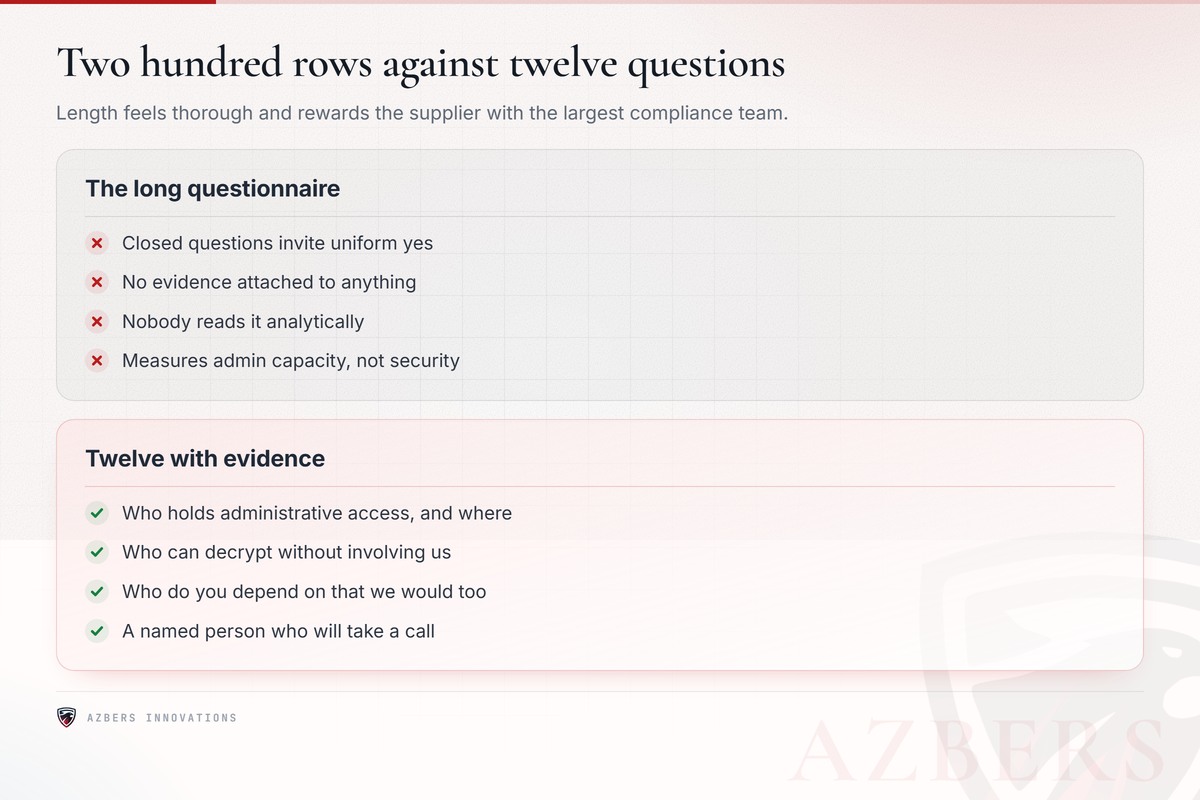
Two hundred closed rows invite uniform yes. Twelve questions with evidence do not.
A long questionnaire feels thorough and behaves badly, for three reasons.
It rewards the wrong supplier. A large vendor with a compliance team answers two hundred questions smoothly. A small specialist with genuinely better security answers them slowly and imperfectly, because nobody there does this full time. You have measured administrative capacity rather than security.
It invites uniform yes. Every question is closed and binary, so the rational strategy for somebody under deadline is to answer yes where anything defensible exists. That is not dishonesty. It is what a closed question with no evidence requirement asks for.
And it converts an assessment into an administrative exercise. Nobody reads two hundred rows analytically. They check for red cells and file it, which means the document's real function is proving that a question was asked.
A questionnaire records what somebody was willing to assert on one particular Tuesday. That is paperwork about assurance rather than assurance.
Ask fewer things and ask for proof
Twelve questions, each requiring a specific answer rather than a yes, each with evidence attached. Anything answered with a policy statement instead of evidence is an answer in itself.
1. Who holds administrative access to the environment our data sits in, and where are those people located. Names not required, roles and jurisdictions are. This one question covers residency, insider risk and the support model at once.
2. Who can decrypt our data without our involvement. If the answer is that they can, every other encryption claim is a policy commitment rather than a technical limit.
3. When did you last have someone independent test this specific service, and may we see the summary and the remediation status. Not whether they do testing. When, on what, and what happened to the findings. A supplier who shares a summary with open items and owners is telling you far more than one who sends a clean certificate.
4. What would tell you that our data had been accessed inappropriately, and how quickly. This asks whether detection exists without letting them answer with a product name.
5. Who do you depend on that we would also be depending on. Their hosting, their identity provider, their payment processor. This is the question almost no questionnaire asks and it is where concentration risk lives, which is the argument in infrastructure fails in chains.
6. Show us your last real incident, and what changed afterwards. A supplier who says they have never had one is either very new or not telling you something. The quality of the answer matters more than the incident.
7. How do you verify identity when somebody calls your service desk asking for a reset. After the last two years of help desk driven intrusions, this is one of the highest yield questions available. We covered why in the breach that starts with a phone call.
8. What happens to our data when we leave, in what format, and how long does it take. Not a security question and it belongs here, because an arrangement you cannot exit is not a choice you keep making.
9. How do you notify us of an incident, to whom, and within what period. Get this into the contract. Most notification clauses are vague enough to be unenforceable, and you will discover that during the incident.
10. Which of your staff or systems can reach our data, and how is that access reviewed. Then ask whether that review covers service accounts, which is usually where it stops. That population is the subject of your machine identities outnumber your people.
11. What AI systems process our data, and can our data be used to train anything. Increasingly the answer has changed since the contract was signed and nobody told you.
12. Who at your organisation is accountable for security, and can we speak to them. A named person who will take a call is worth more than any certificate, and a supplier who cannot produce one has told you where security sits in their structure.
What certificates do and do not tell you
A supplier holding ISO 27001 has done real work, and it is a reasonable floor.
It also certifies a management system against a scope the supplier chose. Read the statement of applicability rather than the certificate, because the scope is where the useful information is and it is common for the certified scope to exclude the service you are buying. Ask for the scope in writing, and check the service you depend on is named in it.
The same applies to any attestation. A report describes a period that has ended, against controls somebody selected. It is evidence, not assurance, and the difference is the whole subject.
Ask proportionately
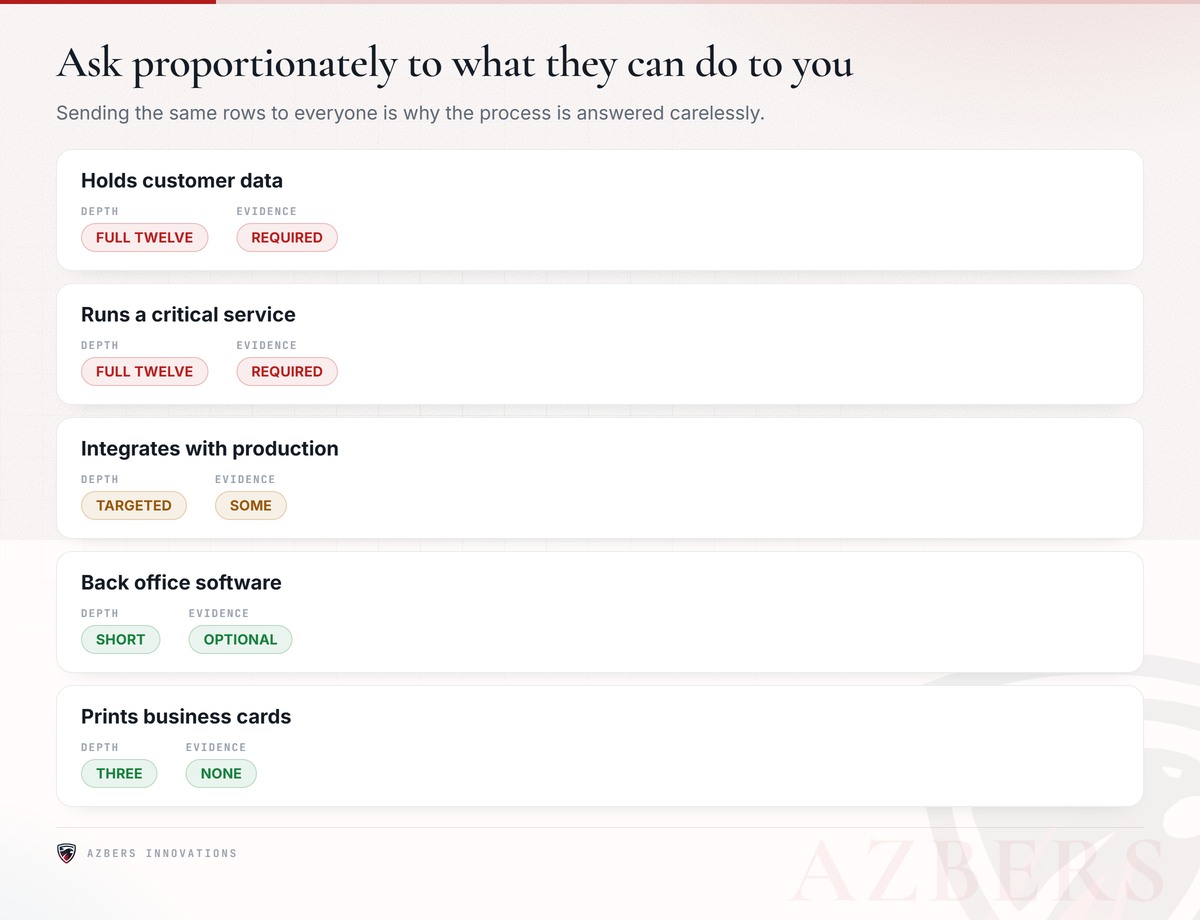
Depth should follow what a supplier can do to you if they fail.
Twelve questions for a supplier holding your customer data. Three for a supplier who prints your business cards.
Most organisations send the same two hundred rows to everyone, which is why the process is resented internally and answered carelessly externally. Tier by what the supplier can actually do to you if they fail, then spend the effort where it changes a decision.
Where we stand
We think the honest position is that supplier questionnaires assure almost nothing on their own, and that the organisations getting value from third party risk work have shifted their effort from asking more questions to asking for evidence and to understanding dependency structure.
We also answer a lot of these ourselves, and we will say plainly that the ones which improve our own security are the short specific ones with evidence attached. The two hundred row spreadsheets improve nothing except the sender's file.
Our GRC practice builds third party assessment around consequence rather than uniform coverage, and our VAPT team tests the suppliers who matter most rather than surveying all of them. ControlGraph holds the dependency structure, so that when a supplier has a bad week the question of what that reaches and who needs to hear about it has an answer the same day rather than after a week of email.
Start here
Take your current questionnaire and find the last supplier who returned it. Ask them question five. Who do you depend on that we would also be depending on.
The answer is frequently a provider you already depend on directly, and you will have learned more from that one question than from the two hundred that preceded it.
Common questions
Are supplier security questionnaires useful
Only weakly on their own. They record what somebody was willing to assert at a point in time, usually without evidence. They become useful when shortened, targeted by consequence, and paired with a requirement to attach proof.
What should you ask a vendor about security
Who holds administrative access and where, who can decrypt your data, when the service was last independently tested and what remains open, what their own critical dependencies are, and how they verify identity at their service desk.
Is ISO 27001 certification enough for a supplier
It is a reasonable floor and not an answer. The certificate covers a scope the supplier defined, so request the statement of applicability and confirm the service you are buying is inside that scope.
How should we tier supplier risk assessments
By what the supplier can do to you if they fail. Suppliers holding sensitive data or providing critical services warrant evidence backed assessment. Low impact suppliers warrant a few questions. Sending the same long questionnaire to everyone wastes effort at both ends.
What is concentration risk in the supply chain
Where many organisations, or many of your own suppliers, depend on the same underlying provider. A single failure then affects everything at once, and it is invisible to assessments that stop at each organisation's own boundary.