The breach that happens inside somebody else's application
Your SaaS platforms hold payroll, customer records and source code, and almost nobody monitors what happens inside them. The attacks landing now do not touch your network at all.
Hilmand Khan28 October 20266 min read
Ask a security team to describe their crown jewels and they will name systems they operate. Ask where their payroll, customer records, contracts, support tickets and source code actually live, and the answer is a list of applications somebody else runs.
Those two answers stopped matching years ago. The monitoring did not follow.
The attacks arriving now reflect that. Nothing touches your network. Nobody drops malware. Somebody signs in to a platform you pay for, using credentials that work, changes a setting nobody reviews, and the loss happens entirely inside an application your security tooling has no visibility into.
What this looks like in practice
The pattern reported through 2025 and into 2026 is almost boring in its simplicity.
An attacker obtains a session or a credential, often through the help desk route we described in the breach that starts with a phone call. They sign in to a human resources or payroll platform. They change the bank details on a set of employee records. Salaries pay out to accounts they control. Nobody notices until payday.
There is no exploit in that sequence. Every action is a supported feature used by an authorised session.
A second pattern is quieter and worse. An attacker persuades a user to approve an OAuth application, or creates one as an administrator. That application receives a token with broad scopes, and from then on it reads mail, files or records continuously without needing the user's password again. Changing the password does not revoke it. Most organisations have never looked at the list of approved applications in their tenant, and when they do, they find entries nobody recognises.
Your security stack is watching the doors of a building your data moved out of.
Why the usual controls miss it
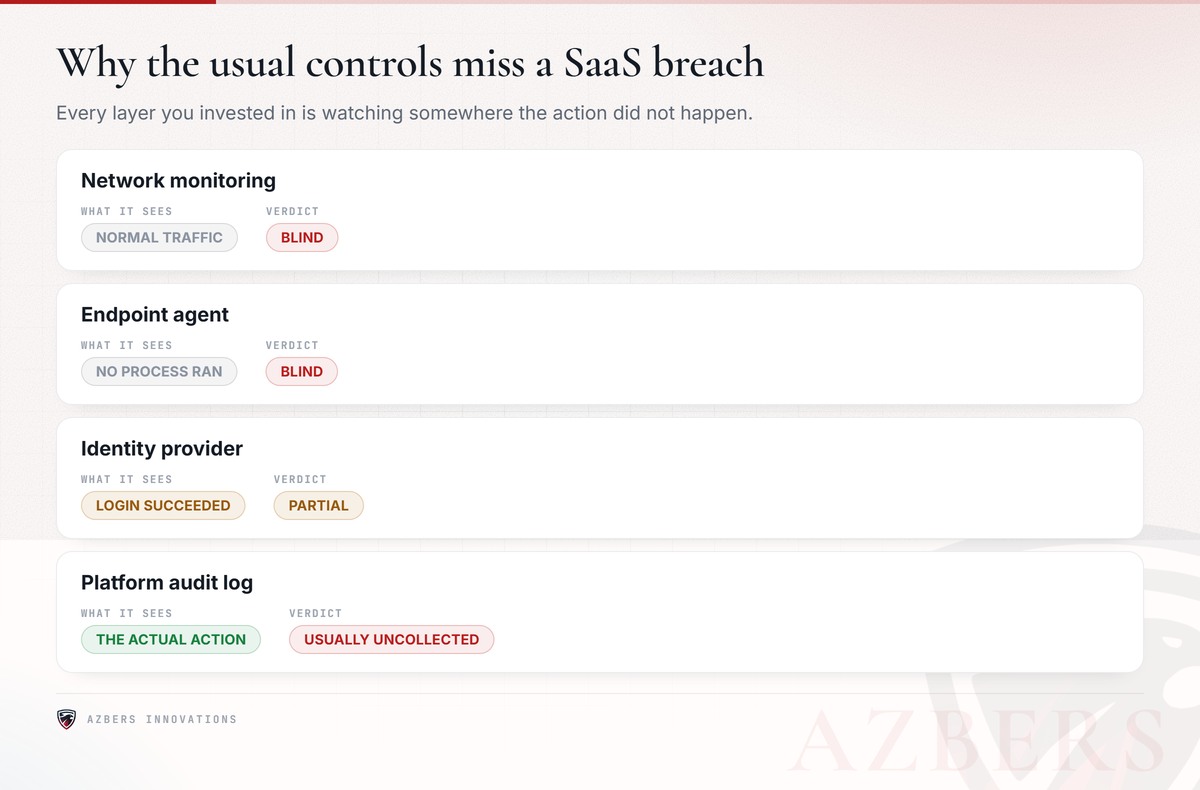
Network, endpoint and identity tooling each see a fragment. The platform audit log sees the action.
The network sees nothing. The traffic is a browser talking to a legitimate cloud service over a normal connection. There is nothing anomalous to inspect.
The endpoint sees nothing. No process ran. The action happened server side, in somebody else's data centre.
The identity provider sees a successful login. That is all it sees. Whether that session then changed two hundred bank records or read one document is not information the identity provider holds.
The platform's own logs are usually not collected. They exist, often at an additional licence tier, and almost nobody ingests them. This is the single largest gap, and it is a procurement decision rather than a technical one.
The five things worth doing
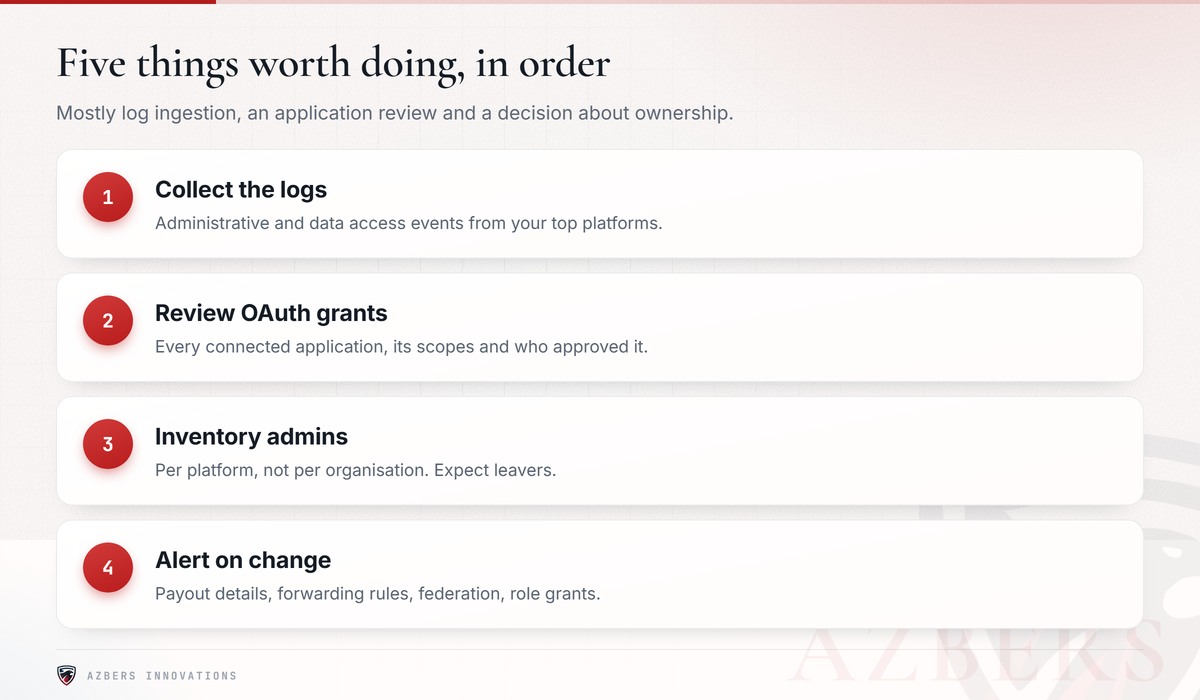
Collect platform logs, review OAuth grants, inventory admins, then alert on configuration change.
Get administrative and audit logs out of your major platforms. Start with the three or four that hold the most sensitive data. If the audit log is behind a higher tier, that cost is the price of being able to investigate at all, and it is worth arguing for explicitly rather than discovering during an incident.
Review OAuth and connected applications. In each major tenant, list every third party application with granted scopes, who approved it and when. Remove what nobody can justify. Then restrict who can approve new ones, because user consent by default is how the list grew.
Inventory administrators per platform. Not per organisation. Per platform. Nearly every organisation finds administrators in a SaaS tenant who left the company, changed role, or were added for a project that ended. These accounts are outside the leaver process because the platform was procured by a department rather than by IT.
Alert on configuration change, not just login. The events that matter are changes to bank details, payout destinations, mail forwarding rules, federation settings, data export and role grants. Each of those is a small number of events per month in a healthy organisation, which makes them cheap to alert on and unusually high signal.
Decide who owns each platform. Most SaaS is bought by the team that uses it, and security ownership is never assigned. Without a named owner there is nobody to ask whether a setting change was expected.
The questions to ask before you buy
This is the same discipline as the supplier questionnaire, narrowed to the platform case. Four questions decide whether you will be able to defend it.
Does it produce an audit log covering administrative and data access actions, and is that log available at our tier. Can we export it to our own systems, and how. Does it support our identity provider for single sign on and for automatic deprovisioning. And can we restrict which third party applications users may approve.
A platform that fails the first two is one you will not be able to investigate. That is worth knowing at procurement rather than afterwards.
Where the frameworks are going
Control frameworks were written for organisations that ran their own systems, and the language has been catching up. ISO 27001 Annex A covers cloud service use explicitly, and national frameworks including PISF treat data held by a supplier as in scope for your own assessment.
The practical consequence is that asset inventory now has to include applications you do not run, with an owner and a data classification for each. Most inventories still stop at hardware and virtual machines, which means the systems holding the most sensitive data are the ones missing from the register.
Where we stand
We think the honest summary is that most organisations have excellent visibility into the systems that matter least to them.
That is not incompetence. It is a decade of tooling investment aimed at a perimeter that made sense when the data was inside it. Correcting it is mostly unglamorous work, which is log ingestion, an application review and a decision about who owns what.
Our GRC practice builds SaaS into asset inventory and access review rather than treating it as a separate cloud project, and our SOC design and monitoring work covers the ingestion and the small set of configuration change detections that carry most of the value. Our VAPT team tests tenant configuration, which is where the exposure usually turns out to be rather than in the platform itself.
CyberNexus holds the record that an application review happened and who accepted the result, because this is a control that decays quietly between reviews. ControlGraph answers the question that follows a finding here, which is what else that platform connects to.
Start here
Open your main identity provider and list every third party application with granted access to your tenant.
Count how many you can name. Most teams stop somewhere in the first ten and then keep scrolling, and that gap is the finding.
Common questions
What is a SaaS breach
An incident occurring inside a cloud application you subscribe to rather than on infrastructure you operate. The attacker typically uses valid credentials or an approved integration, so no exploitation or malware is involved.
Why do traditional security tools miss SaaS attacks
Network monitoring sees ordinary encrypted traffic to a legitimate service, endpoint tooling sees no process because the action happens server side, and the identity provider records only that a login succeeded, not what the session then did.
What SaaS logs should we collect
Administrative action logs, data access and export events, authentication events, and configuration changes covering payout details, mail forwarding, federation and role grants. Start with the platforms holding your most sensitive data.
How do attackers abuse OAuth applications
They obtain approval for an application with broad scopes, either by persuading a user to consent or by creating one with administrative access. The resulting token keeps working independently of the user's password, so a password reset does not revoke access.
Who should own SaaS security
A named owner per platform, agreed between the team that procured it and security. Without that, configuration changes have nobody to validate them and the platform sits outside joiner and leaver processes.