Starting a Qatar information assurance programme without starting at the controls
Most teams open the control list first. The framework does not expect that, and beginning there is why programmes stall six months in. The right order costs less and finishes sooner.
Azhar Ghafoor15 July 20265 min read
A team is told they need to be compliant with Qatar's national information assurance requirements. Within a week somebody has the control list open in a spreadsheet and is assigning owners to individual items.
It is the natural thing to do and it is the wrong end. Six months later the programme is usually stuck, with controls half implemented against systems nobody agreed were in scope, protecting data nobody has classified, at a level nobody can justify.
The framework does not ask you to start there. Working in the order it actually expects is cheaper, faster, and considerably easier to defend when somebody audits it.
Why the control list is the wrong first step
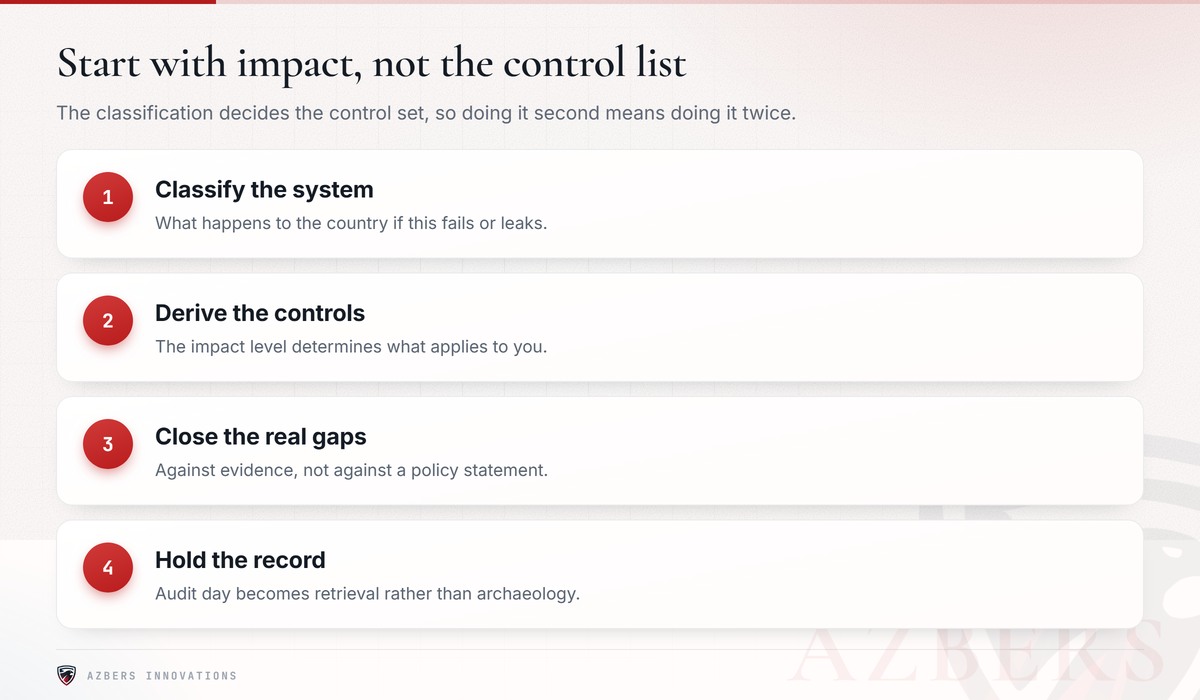
Classify the system by impact first, because the impact level decides the control set.
A control list tells you what could be required. It cannot tell you what is required of you, because that depends on two things the list does not know.
What you hold, and how sensitive it is. And which of your processes actually matter to the organisation and to the people who depend on it.
Until both are settled, every control decision is a guess. Teams that guess tend to over apply controls to things that do not need them, under apply them to things that do, and end up unable to explain either choice. That inability to explain is what turns an audit conversation difficult, far more than any individual gap.
Nobody has ever struggled in an audit for having a gap they understood. The trouble starts with a control nobody can justify applying or omitting.
The order that works
Start with impact. Which business processes cannot stop, what happens when they do, and who is affected. This is a business conversation, not a technical one, and it needs people outside IT in the room. The output is a short ordered list of what actually matters.
Then classify the data. What the organisation holds, grouped into categories, each with a sensitivity level. The mistake here is inventing a scheme. Use the classification levels the national framework already defines, because you will eventually have to map to them anyway and doing it twice is wasted work.
Then set scope. Which systems process or store which categories. This is where most of the argument happens, and it is much easier now than it would have been at the start, because the previous two steps have already decided what is at stake.
Then select controls. Now the control list becomes useful, because each decision has a reason behind it that somebody can state in a sentence.
Then attach evidence as you go. Not at the end. Proof captured at the moment the work happens is stronger and considerably cheaper than proof reconstructed eleven months later. We wrote about why in what continuous compliance actually means.
Then assemble the submission. If the previous step was done properly, this is an export rather than a rebuild.
The two things that derail programmes
Classification by committee. Every category becomes highly sensitive because nobody wants to be the person who under classified something. The result is a scheme that protects everything equally, which means it prioritises nothing, and the cost lands on the business until the controls quietly stop being followed. Somebody senior has to be willing to say that a category is ordinary.
Scope creep through uncertainty. When nobody is sure whether a system is in scope, it gets included to be safe. Ten of those decisions and the programme is twice the size it needed to be. The impact analysis is what lets you make that call deliberately.
What an auditor is actually looking for
The same thing any assessor looks for anywhere. Not perfection. Evidence that you understand your own position and can account for how you reached it.
An organisation with open items, each with a named owner, a date and a reason, reads as being in control. An organisation with fewer open items and no explanation for how the rest closed reads as one that has not looked carefully. The second has better numbers and the worse position. We went into that at more length in what a regulator actually wants to see.
Where to get the requirements themselves
Go to the source rather than a summary. Qatar's National Cyber Security Agency is the authority for the national requirements and their current form, and the published material is what an auditor will hold you to rather than anybody's interpretation of it.
For the surrounding practice, the NIST Cybersecurity Framework is a useful common vocabulary for the internal conversation, and the CIS Controls are a sensible prioritised answer to what to implement first where the national requirements leave room for judgement.
Where our work fits
ComplianceVault is built around exactly this order. Impact analysis, then classification, then control assessment with evidence attached at the point of work, then an audit pack assembled from the same records the team has been using all year. It knows one framework properly rather than many loosely, which is what a team in the middle of a programme actually needs.
Where an organisation answers to this and to international standards at the same time, the duplication becomes the dominant cost, and that is the problem ControlGraph is built to hold. We also run the delivery work directly through our GRC service where a team needs hands rather than software.
Common questions
Where should a Qatar information assurance programme start
With business impact analysis and data classification, not with the control list. Control decisions only become defensible once you know what you hold, how sensitive it is, and which processes genuinely matter to the organisation.
How long does a programme like this take
It depends far more on your starting point than on the framework. Organisations with existing operational discipline and a reasonable asset picture move quickly. Those starting without either spend most of the time on the first two steps, which is time well spent rather than time lost.
Do we need to classify everything before we start on controls
Not to complete perfection, but enough to know the categories and roughly where they live. Waiting for a perfect classification is itself a common way for programmes to stall. Get it accurate enough to make scope decisions, then refine as you go.
Can we reuse this work for ISO 27001
A great deal of it, yes. The impact analysis, the classification and most of the control evidence carry across with light editing. The efficient approach is to map the relationship once at the start rather than running two programmes that slowly drift apart.