The phrase is used to sell dashboards. What it really describes is a change in when evidence is produced, and that change is the only part that matters.
Azhar Ghafoor12 September 20265 min read
Continuous compliance is one of those phrases that arrived fully formed and slightly hollow. Every vendor uses it, almost nobody defines it, and the definitions that do exist tend to describe a product rather than a practice.
Here is the version that survives contact with an actual audit.
Continuous compliance means evidence is produced as a by product of the work, at the moment the work happens, rather than gathered in a scramble before somebody arrives to check. Everything else people attach to the phrase follows from that or is decoration.
Why the timing is the whole point
Continuous compliance shortens the gap between a control operating and it being evidenced.
Think about what a traditional cycle looks like.
A control operates all year. Nobody records anything much. Six weeks before the audit, somebody starts collecting proof that it operated, working backwards from a list. They chase colleagues, dig through shared drives, and reconstruct what happened from memory and chat history.
Two things go wrong, and both are structural rather than anybody's fault.
The evidence is weaker than the reality. The control probably did work. But what can be produced eleven months later is thinner than what could have been captured on the day, so the organisation gets assessed on its filing rather than on its security.
And the gap is discovered late. If a control quietly stopped working in March, the cycle finds out in November. That is eight months of believing you were covered, which is worse than knowing you were not.
The point of continuous compliance is not more evidence. It is evidence that was captured while somebody still remembered what happened.
What it looks like in practice
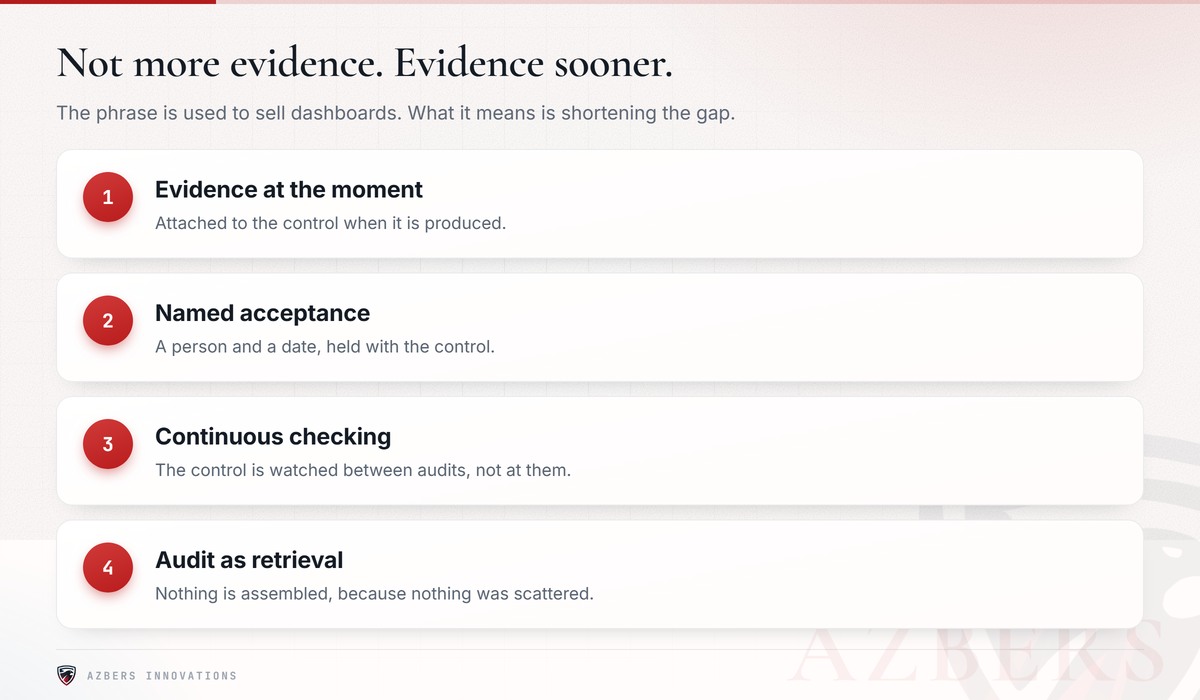
Four things change. None of them require buying anything, although tooling makes them easier to sustain.
Evidence is attached at the point of work. When the access review is completed, the export attaches to the control then. Not later, not by somebody else, not from memory.
Controls have owners who still exist. Ownership is checked as a matter of routine, so a control whose owner left in April does not sit unowned until the next cycle finds it.
Drift raises its hand. Something has to notice when a control has not been confirmed within its expected interval and say so, quietly, while the gap is still small.
Closure requires proof. An item does not close because a task finished or a sprint ended. It closes against evidence a named person accepted, and that acceptance stays with the record.
If those four are true, you have continuous compliance, whether or not anything on your estate is called that. If they are not true, a dashboard showing a green percentage is describing your filing system rather than your security.
How to tell whether you have it
There is a test that takes ten minutes and is slightly uncomfortable.
Pick five controls at random. Not the five you feel good about. For each, try to produce the current supporting evidence without contacting the person who owns it.
Can you find it at all
Is it dated within the interval the control claims
Does it say who accepted it
Would you notice if it stopped being produced
Whatever you cannot answer is the gap. Most organisations manage the first question and struggle from the second, which is a very normal place to be and an easier one to fix than it looks.
Where automation genuinely helps, and where it does not
Automation is good at the collection and the noticing. Pulling a configuration state on a schedule, checking a review happened within its window, flagging a control that has gone quiet. This is repetitive, exact work and machines are better at it than people.
Automation is bad at judgement. Whether a particular piece of evidence actually satisfies a particular obligation is a decision somebody has to be willing to defend. We have written about where that line sits in whether AI belongs in compliance work, and the same argument applies to any automation, not just the fashionable kind.
The failure mode to watch for is a platform that marks things satisfied on your behalf. It looks like progress and it quietly moves accountability from a named professional to a process nobody can question. That is the opposite of what the exercise is for.
This is the reasoning behind how CyberNexus handles closure. A control closes against evidence a reviewer accepted, and the history of how it got there stays attached, because the question that eventually gets asked is not whether the control was satisfied but who decided that it was.
Where to start if you are starting
Do not try to convert everything. Pick the five controls you are asked about most often, and change only when their evidence is produced.
Attach proof at the point of work for those five. Give each a named owner and an interval. Set something to notice when the interval passes. That is a month of effort for the controls that carry most of your audit exposure, and it will tell you quickly whether the approach is worth extending.
The NIST Cybersecurity Framework is a reasonable structure for deciding which five, and the CIS Controls are a good prioritised answer to what should be in place at all.
Common questions
Is continuous compliance the same as compliance automation
No, although they are often sold together. Automation is about who or what collects the evidence. Continuous compliance is about when it is collected. You can be continuous with almost no automation, and you can automate heavily while still producing everything in a panic before an audit.
Does this mean we still need an annual audit
Yes, where you are obliged to have one. What changes is the experience of it. An organisation producing evidence continuously spends audit season confirming a position it already knows, rather than reconstructing one it has to hope is defensible.
How do we convince leadership to fund this
Frame it as audit cost and surprise risk rather than as security maturity. The two numbers that land are how many person weeks the last audit consumed in preparation, and how long a control could be broken before anyone would notice. Both are usually higher than leadership expects.
Will auditors accept continuously collected evidence
Generally they prefer it, because evidence captured at the time of the activity is stronger than evidence reconstructed afterwards. What matters is that it is attributable, dated and complete rather than how frequently it was gathered.