Most insider risk is not malicious, and that is the problem
The insider programme most organisations built watches for a disgruntled employee stealing files. The incidents that actually happen involve a helpful person, a deadline and a tool nobody approved.
Azhar Ghafoor5 November 20266 min read
Insider threat programmes are usually built around a story. Somebody is passed over for promotion, becomes resentful, and starts copying files before they resign.
That story is real and it is rare. A large share of breaches involve a human element, and most of that share is not malice. It is a person trying to do their job faster than the tools allow.
The gap between the programme and the reality matters, because controls designed to catch a thief are the wrong controls for catching a rushed colleague, and they carry costs that make the organisation worse at the same time.
What the incidents actually look like
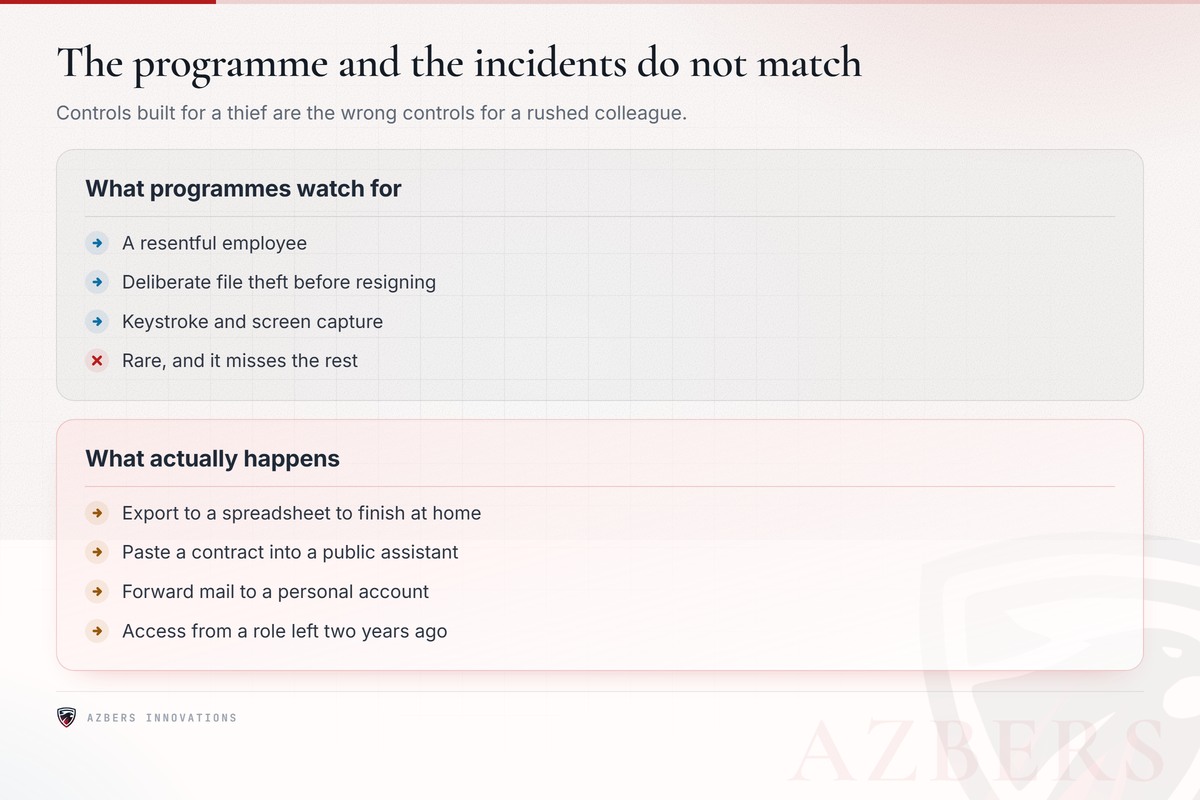
Insider programmes watch for deliberate theft while the incidents involve deadlines and workarounds.
Somebody exports a customer list to a spreadsheet to work on it at home, because the reporting tool cannot produce what they need.
Somebody pastes a contract into a public AI assistant to get a summary before a meeting, because reading it properly would take an hour they do not have. This is the behaviour we wrote about in shadow AI at work, and it has not slowed down.
Somebody forwards their work mail to a personal account so they can answer messages on a phone that is not enrolled.
A developer hardcodes a credential to get a build working, intending to remove it, and does not.
Somebody with access they no longer need, from a role they left two years ago, uses it because it was still there and it was convenient.
None of these people are attacking you. Every one of them has created an exposure that looks identical in a log to one that was deliberate.
Nearly every accidental insider incident is a person routing around a control that made their job harder without being told why.
Why surveillance is the wrong first answer
The instinct is to watch harder. Keystroke logging, screen capture, sentiment scoring on internal messages.
Three problems with leading on that.
It produces enormous volume and very little signal, which lands you in exactly the position described in the alert queue nobody works.
It damages the reporting culture you depend on. The single most valuable control against insider incidents is a person saying they think they made a mistake. Staff who believe they are being scored do not volunteer anything, and you lose early warning on the incidents that matter most.
And in several jurisdictions it carries real legal constraints around proportionality and employee privacy that are worth understanding before deployment rather than after.
Monitoring has a place. It belongs after the structural work, aimed at specific high consequence actions, and it should be disclosed rather than covert.
What works better
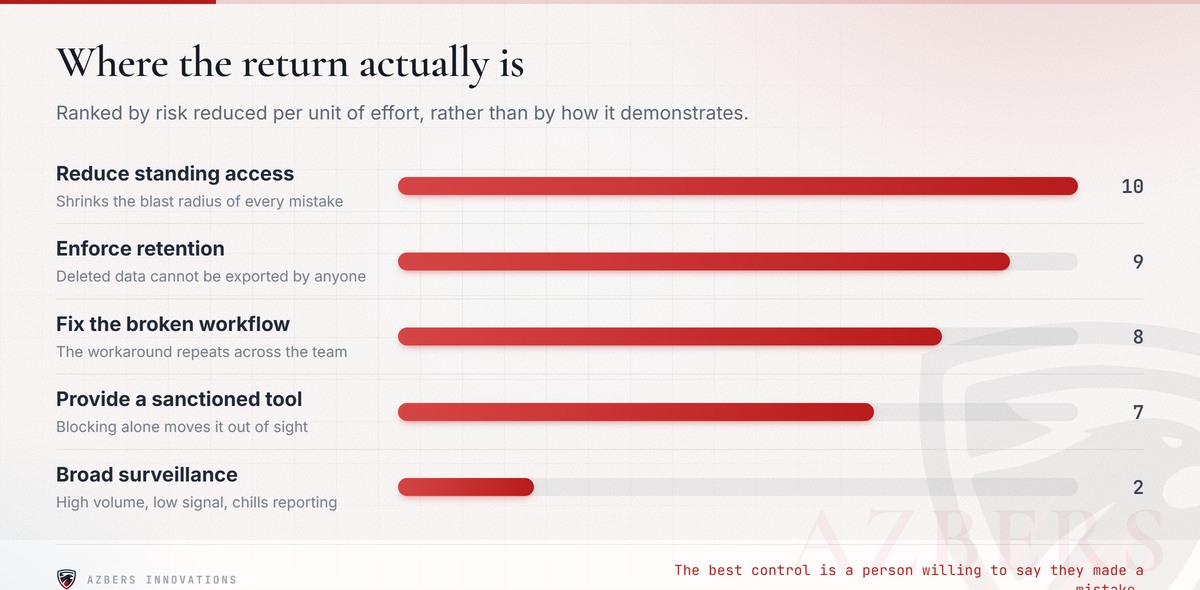
Reducing standing access and enforcing retention return more than broad surveillance.
Reduce standing access. Most accidental exposure involves data the person did not need that day. Access on request, scoped and time limited, shrinks the blast radius of every mistake at once. It is the same principle as the machine identity problem in your machine identities outnumber your people, applied to staff.
Hold less. Data you deleted on schedule cannot be exported by anyone. Retention enforcement is unglamorous and it reduces more risk per unit of effort than most monitoring.
Fix the reason. When somebody exports to a spreadsheet, the useful question is what the reporting tool cannot do. Insider incidents cluster around broken workflows, and the same workaround usually appears repeatedly across a team. Treating each instance as a discipline matter guarantees it happens again quietly.
Provide the sanctioned version. Blocking public AI assistants without offering an approved alternative produces the same behaviour on personal devices where you cannot see it at all. Give people something that works and most of the shadow usage ends.
Alert on a small number of high consequence actions. Bulk export of sensitive records, mail forwarding rules to external addresses, access grants outside the normal process, and mass download shortly after a resignation. Each is low volume and high signal, and together they cover most of what a programme needs.
Make leaving a process. A large share of insider incidents cluster around departure. Know what a leaver had access to, remove it on the day, and check what was downloaded in the final fortnight.
The uncomfortable case
Some incidents are deliberate, and a programme has to handle that without treating everyone as a suspect.
The answer is to prepare the response rather than to widen the surveillance. Know in advance who is involved when a case is suspected, which is normally legal, human resources and a senior security lead. Know what evidence you can lawfully collect and how to preserve it, because the technical instinct to investigate immediately can destroy admissibility. Our DFIR practice works these cases, and the most common mistake we see is a well meaning administrator reimaging the machine before anybody imaged it.
Where we stand
We think most organisations should spend far less on watching people and far more on reducing what a mistake can reach.
That position is less satisfying than a product purchase and it is what the evidence supports. An organisation with tight standing access, enforced retention and a culture where people report their own errors will have fewer insider incidents and smaller ones than an organisation with comprehensive monitoring and none of the above.
Our GRC practice builds access review and retention into one programme rather than two, because they solve the same problem from different ends. Our security awareness work is built around why a control exists rather than a list of prohibitions, since a control somebody understands is one they route around less.
CyberNexus keeps the record of access decisions and exceptions with a named approver, which is what lets you answer the question that arrives after an incident, which is who granted this and on what basis.
Start here
Pick one person who left in the last six months. List what they still have access to.
If anything remains, you have found a control gap that costs nothing to fix and would have been very expensive to discover the other way.
Common questions
What is insider risk
Exposure created by people with legitimate access. It covers deliberate misuse, but the majority of incidents are accidental or driven by convenience rather than intent.
Are most insider incidents malicious
No. The larger share involve carelessness, workarounds and people trying to complete work faster than the available tools allow. Controls designed only for deliberate theft miss most of what actually happens.
Does employee monitoring reduce insider risk
Only narrowly, and it carries costs. Broad surveillance generates unmanageable volume, suppresses self reporting, and faces legal limits in many jurisdictions. Targeted alerting on a few high consequence actions works better.
What are the highest value insider risk controls
Reducing standing access, enforcing data retention, providing sanctioned tools so people do not use unsanctioned ones, and a leaver process that removes access on the day and reviews recent downloads.
How should we handle a suspected malicious insider
Involve legal and human resources before acting technically, preserve evidence properly rather than investigating on the live machine, and follow a process agreed in advance. Premature remediation frequently destroys the evidence a case would need.