Your staff are pasting company information into AI tools today. A ban will not stop it, it will only stop you seeing it. Here is the position that actually works.
Azbers Innovations30 August 20265 min read
Somebody in your finance team used an AI tool last week to summarise a contract. Somebody in engineering pasted a stack trace with a customer identifier in it. Somebody in HR drafted a difficult letter with details that should never have left the building.
None of them were being reckless. All three were trying to do their job faster with a tool that is genuinely good at what they asked it to do.
This is shadow AI, and the useful question is not whether it is happening in your organisation. It is whether you can see it, and whether anyone has told people where the line is.
Why banning it does not work
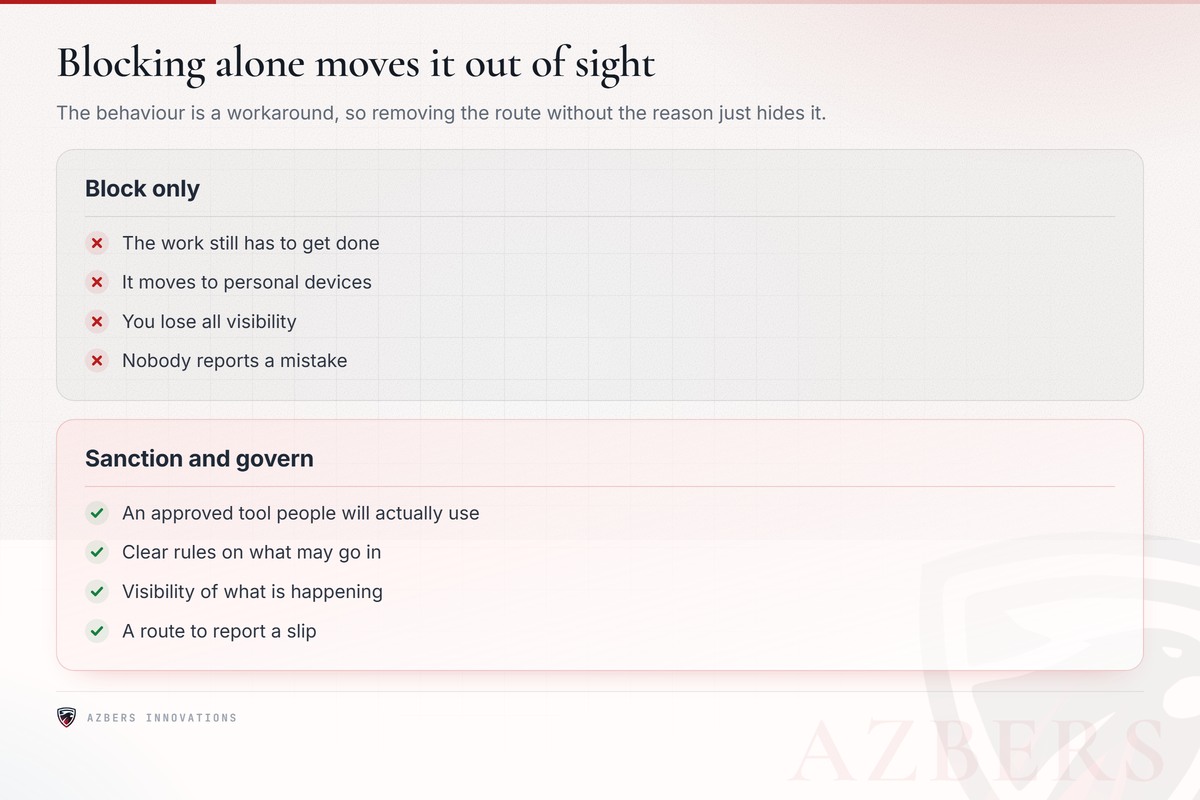
Blocking without a sanctioned alternative moves the behaviour somewhere you cannot see.
The instinct is to prohibit it, and it is understandable. It is also the option that produces the worst outcome, for a reason that has nothing to do with AI.
A ban does not remove the pressure that created the behaviour. The deadline is still there, the tool still works, and the tool is available on a personal phone with no corporate network in the way. What the ban removes is your visibility, because now the activity moves somewhere you cannot see it and nobody will report a mistake made while breaking a rule.
This is the same shape as every shadow IT problem of the last twenty years. File sharing, messaging, personal cloud storage. Every one of them went the same way, and the organisations that came out best were the ones that provided a sanctioned route that was easier than the unsanctioned one.
A rule people cannot follow does not change behaviour. It changes what they tell you about their behaviour.
What to publish instead
You do not need a long policy. You need a short, readable position that a person can hold in their head, and it needs to answer three questions.
Which tools are approved. Name them. A list of two or three specific tools is enormously more useful than a paragraph about approved categories, because people will otherwise make their own judgement and they will make it generously.
What must never go in. Be concrete and use your own vocabulary. Customer records, anything covered by a confidentiality clause, credentials, unreleased financials, personal data of staff. A list somebody can actually check against.
What to do if it already happened. This one is usually missing and it matters most. If somebody realises they pasted something they should not have, they need to know that reporting it quickly is the right move and will not end badly for them. Otherwise it goes unreported, which is the outcome you were trying to avoid.
The four questions to ask any AI vendor
Before a tool goes on the approved list, get written answers to these. Vague answers are an answer.
Do our inputs train your model? If yes, or if it is configurable and the default is yes, that changes what may be pasted into it.
How long is our data retained? Including in logs and in any human review queue, which is the part people forget.
Which regions process it? This is the question that decides whether the tool is usable at all under some obligations.
Who at your company can read it? Support, engineering and any subprocessor sitting behind the service.
Everything above is about people pasting text into a chat window. There is a second category that deserves its own treatment, and it is growing faster.
An AI assistant connected to your systems, able to read a repository, query a database or open a ticket, is not a chat tool. It is a privileged account. It should be scoped like one, logged like one and reviewed like one.
Decide what it may read, what it may change, and what always requires a person to approve. Log its actions where you log everyone else's, because after an incident you will need to know what it did, and an assistant whose actions are invisible is an assistant you cannot investigate.
Before writing anything, find out where you stand. Three sources, in order of how quickly they pay off.
Ask. A short anonymous question to staff about which AI tools they use for work produces a more honest picture than most technical controls will, and it takes an afternoon.
Look at outbound traffic. Your existing tooling probably already shows which AI services are being reached from the corporate network, even if nobody has looked at it through that lens.
Check expenses. Personal subscriptions to AI tools reimbursed on expenses are a reliable indicator of what people find genuinely useful.
Then write the position, name the approved tools, and make the approved route the easy one. That is the whole intervention, and it works better than prohibition because it is aligned with what people are already trying to do.
Common questions
Should we block AI tools on the corporate network
Blocking without providing an alternative moves the activity to personal devices, where you have no visibility at all. If you block, provide a sanctioned tool at the same time and make it genuinely easier to reach than the alternatives.
What is the biggest shadow AI risk
Not the dramatic one. It is ordinary confidential information leaving in ordinary volumes, pasted by people doing their jobs, with no record of what went where. The absence of a record is what makes it hard to assess afterwards.
Do we need a separate AI policy
Usually not a separate document. Most organisations are better served by a short addition to existing acceptable use and data handling policies, naming approved tools and prohibited data categories, because a separate policy is one more thing nobody reads.
How do we monitor AI use without surveilling staff
Monitor at the service level rather than the person level. Knowing which tools are being reached and in what volume tells you what you need for a policy decision, without reading individual content, and it is far less corrosive to the reporting culture you actually depend on.