Nearly everyone reports having started and almost nobody reports having finished. The phrase describes a direction rather than a product, and the organisations making progress all sequence it the same way.
Hilmand Khan13 November 20266 min read
Zero trust has been the most oversold phrase in security for several years, which is unfortunate, because the underlying idea is both simple and correct.
Survey after survey reports most large organisations having implemented at least part of it, and very few reporting completion. That pattern is not a failure of effort. It reflects something true about the model, which is that it is a direction of travel rather than a state you reach, and that the early parts are far easier than the later parts.
The idea, without the vendor framing
The traditional model granted trust by location. Inside the network was trusted, outside was not, and the security effort went into the boundary between them.
Two things broke it. The data moved to applications you do not run, and the people moved to places that were never inside. There is no longer a meaningful inside.
So the model becomes: verify every request explicitly, grant the least access that works, and assume a breach has already happened somewhere. The authoritative description is in NIST Special Publication 800-207, which is readable and vendor neutral and worth an hour.
Nothing in that document is a product. Every part of it is a change to how access decisions get made.
Zero trust is not a thing you install. It is the removal of a shortcut your architecture has relied on for thirty years.
Why programmes stall in the same place
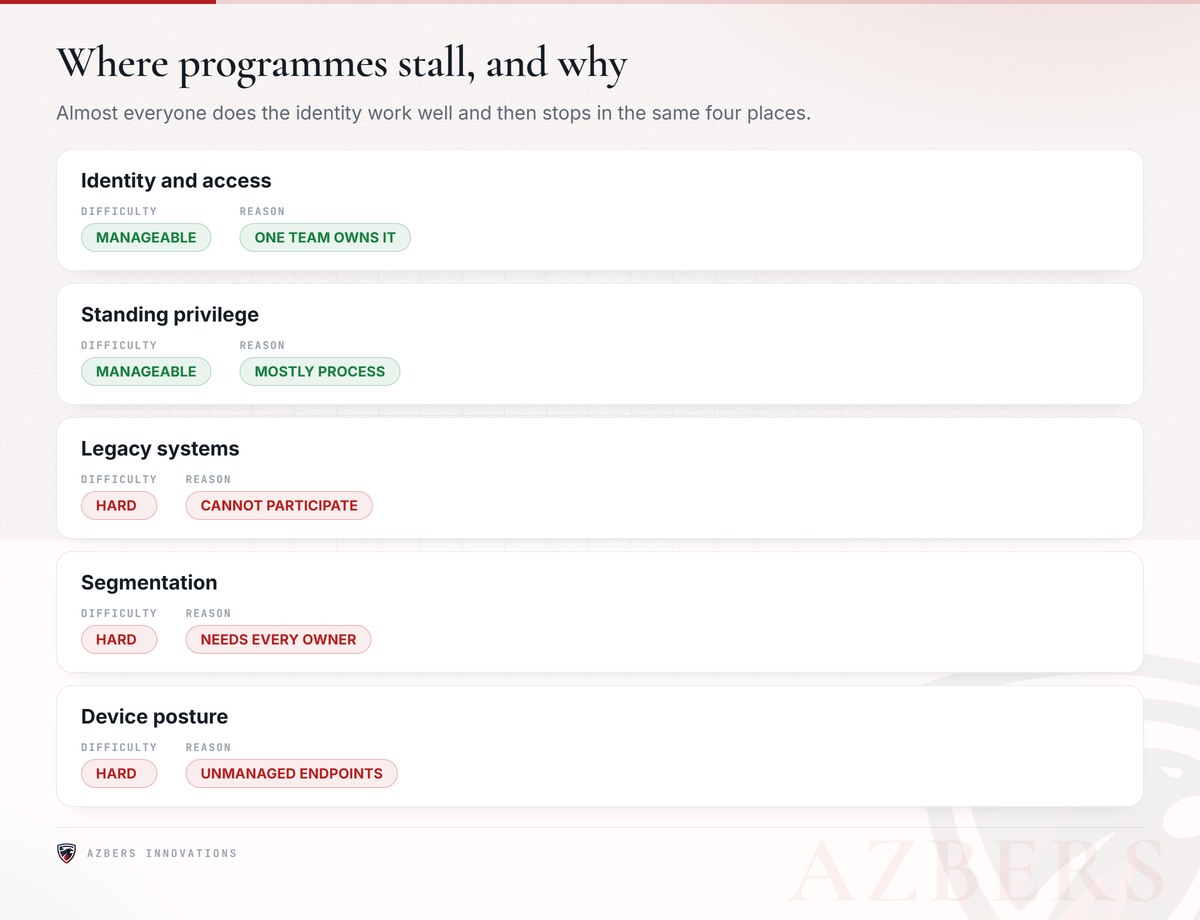
Identity work is manageable. Legacy systems, segmentation and device posture are where programmes stop.
Almost everyone starts with identity, because it is the highest return and the tooling is mature. Single sign on, strong authentication, conditional access. That work goes reasonably well and delivers real improvement.
Then it stops, for four predictable reasons.
The legacy estate cannot participate. An application that only speaks an old protocol cannot honour a modern access decision. Every organisation has some, and they are usually important.
Segmentation touches everything. Identity can be improved centrally by one team. Network and application segmentation requires cooperation from every team that owns a system, which makes it a political programme rather than a technical one.
Nobody knows what talks to what. You cannot write a least privilege policy for traffic you cannot describe. Most organisations discover their dependency map does not exist, and building it is a project nobody scoped.
Device posture is genuinely hard. Verifying the health of a device works well for managed laptops and poorly for contractors, personal phones and anything a supplier brings.
None of these are reasons not to proceed. They are reasons to sequence deliberately rather than to buy a platform and hope.
A sequence that gets somewhere
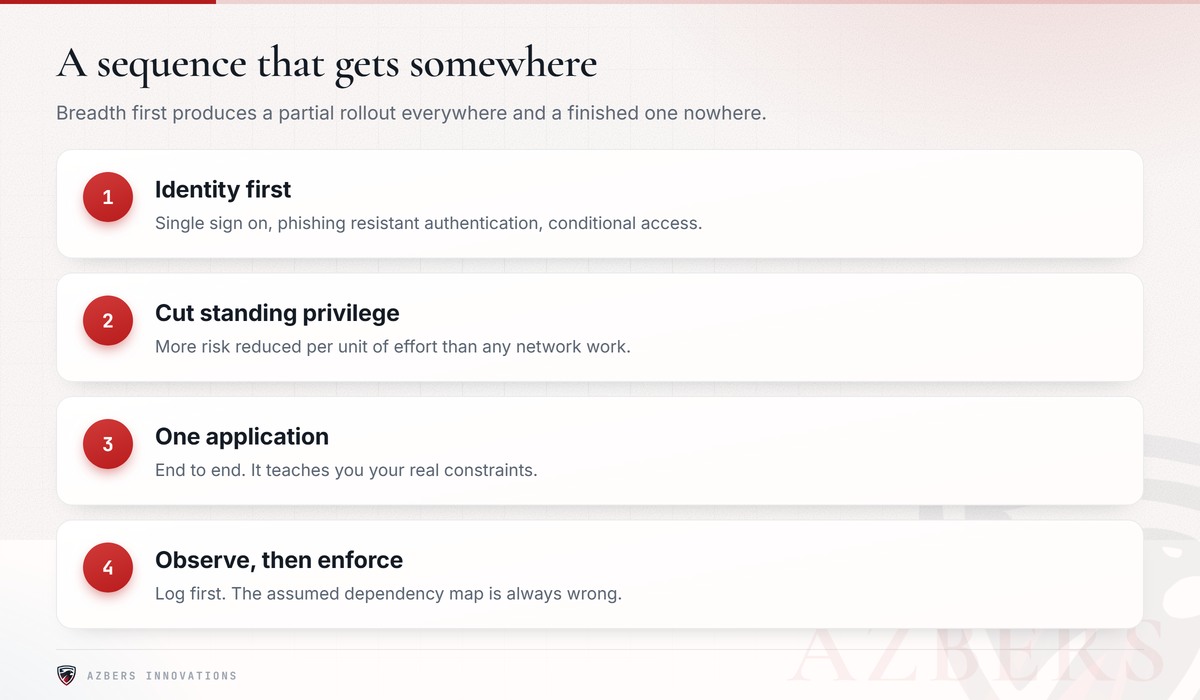
Identity, then standing privilege, then one application end to end, then observe before enforcing.
Identity first, properly. Single sign on everywhere it is possible, phishing resistant authentication for privileged access, and conditional access that considers device and context rather than only credentials. On authentication specifically, the practical move is covered in passkeys are ready, your rollout is the hard part.
Then cut standing privilege. Access granted on request, scoped and time limited, rather than held continuously. This delivers more risk reduction per unit of effort than any network work, and it applies equally to the machine identity population described in your machine identities outnumber your people.
Then one application, end to end. Pick a single important application and make every access decision to it explicit and verified. Doing one properly teaches you your real constraints, and it produces a pattern the next ten can follow. Attempting breadth first produces a partial rollout everywhere and a finished one nowhere.
Then map dependencies. Observe before you enforce. Run in logging mode long enough to learn what actually talks to what, because the guess will be wrong and enforcing a wrong guess is how a programme loses its sponsor.
Then segment, gradually. Start by separating what would hurt most, which is usually administrative access paths and the systems holding regulated data. Whole estate microsegmentation is a fine ambition and a poor first objective.
Then the legacy problem, deliberately. For each system that cannot participate, decide whether it gets a proxy in front of it, gets isolated, or gets an accepted and documented exception with a named owner and a review date. What does not work is leaving it undecided, because undecided becomes permanent.
What the regulators are doing
Nobody writes zero trust into law by name, and the requirements increasingly describe it anyway.
European regulation for essential entities and financial services points at strong authentication, access control and segmentation as risk management measures. National frameworks are aligned in substance, and PISF treats identity, access and monitoring as core domains with evidence expected rather than asserted.
The practical consequence is that the identity and access work carries compliance value as well as security value, which usually makes it the easiest part of the programme to fund.
Where we stand
We think most organisations should stop describing their programme as zero trust and start describing the specific thing they are doing this quarter.
The phrase has become a way of implying broad progress while the hard parts stay untouched. An organisation that has done single sign on and calls itself zero trust has done something genuinely valuable and has not done the thing the phrase claims. Being precise internally about which parts are done is what stops a programme quietly stalling with a sponsor who believes it finished.
We also think observe before enforce is the single most useful discipline here. Nearly every painful segmentation rollout we have been asked to help with went to enforcement on an assumed dependency map.
Our GRC practice sequences the programme against the frameworks you already answer to, so the work counts twice, and our VAPT team validates segmentation by trying to cross it, which is the only way to know whether a policy does what its author intended. ControlGraph holds the dependency structure that a least privilege policy depends on, because policy written against an unknown map is a guess with a configuration file.
Start here
Pick your most sensitive application. Write down every route by which a person or a system can reach it today.
If that list takes more than an afternoon to produce, or if people disagree about it, you have found the reason your segmentation work has not started.
Common questions
What is zero trust
An architectural approach that removes implicit trust based on network location. Every request is verified explicitly, access is granted at the least level that works, and the design assumes a breach has already occurred somewhere.
Is zero trust a product
No. It is a set of architectural principles described in NIST SP 800-207. Products can support parts of it, particularly identity and access, but no purchase delivers it.
Where should a zero trust programme start
Identity. Single sign on, phishing resistant authentication for privileged access, and conditional access. Then reduce standing privilege, then take one important application end to end before attempting breadth.
Why do zero trust programmes stall
Legacy systems that cannot participate in modern access decisions, segmentation requiring cooperation across every system owner, missing dependency maps, and device posture being difficult for unmanaged endpoints.
Does zero trust satisfy compliance requirements
No framework requires it by name, but the measures it produces, strong authentication, access control, segmentation and monitoring, map directly onto what European and national frameworks ask for, so the work generally counts towards both.