What a SIEM actually costs, and why the bill surprised you
The licence was never the expensive part. Ingestion grows on its own, tuning never ends, and the people needed to operate it cost more than the platform. How to budget honestly before you sign.
Hilmand Khan9 November 20266 min read
Very few security purchases produce as much frustration a year later as a SIEM, and it is rarely because the product was bad.
It is because the thing that was budgeted was a licence, and the thing that arrived was an operating commitment. The licence is usually the smallest of the three real costs, and the other two grow whether or not anybody is paying attention.
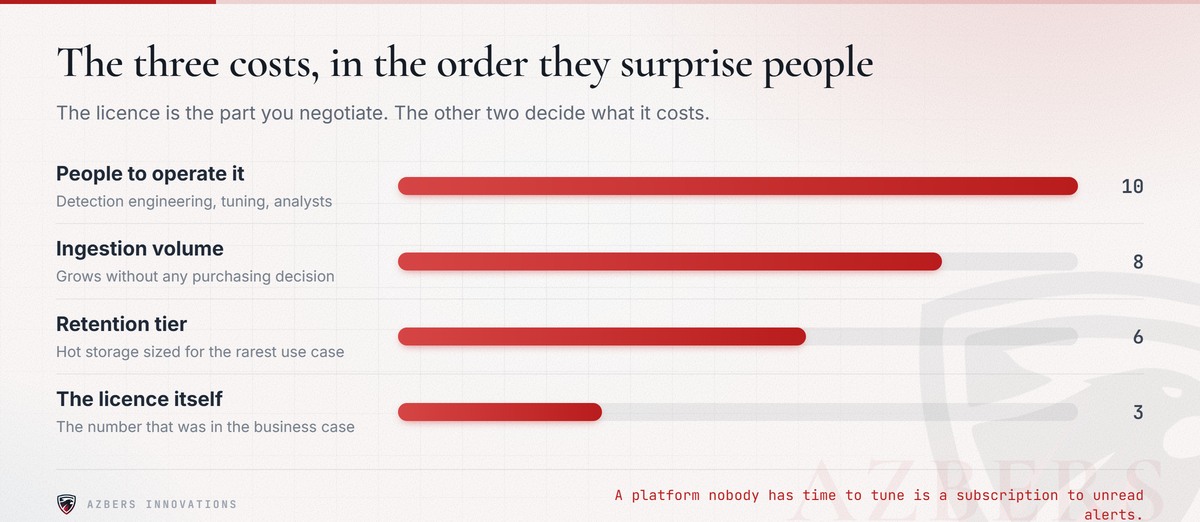
The three costs, in the order they surprise people
People cost more than ingestion, ingestion costs more than the licence that was budgeted.
Ingestion, which grows on its own. Nearly all pricing keys off data volume, and volume increases without anyone deciding to increase it. A new application goes live. A team enables verbose logging to debug something and leaves it on. Cloud usage rises. Nobody made a purchasing decision, and the bill rises anyway.
Organisations routinely find their second year volume well above their first year estimate, and the estimate was not wrong when it was made.
Retention, which is bought twice. Detection needs recent data and investigation needs old data. Buying hot searchable storage for a compliance retention period is how budgets get destroyed, because the expensive tier is sized for the rarest use.
People, which cost the most. A SIEM does nothing without detection engineering, tuning, and analysts to work what it produces. For most organisations this is the largest line by a clear margin, and it is the one most often absent from the business case, because it appears in a different budget.
The platform is the part you can negotiate. The volume and the staffing are the parts that decide what it costs.
Where the volume actually comes from
Very little of it is security relevant. In most estates the top sources by volume are verbose application logs, load balancer and proxy traffic, and endpoint telemetry at default verbosity.
None of that is worthless. It is simply not worth hot searchable storage at full fidelity when the events that drive detections are a small fraction of the total.
The useful exercise is to rank your sources by volume next to how many of your actual detections and investigations used them. The two lists rarely resemble each other, and the gap between them is your saving.
This is the same prioritisation we set out in a SOC in six months. Identity, endpoint, externally facing services and cloud control plane carry most real intrusion paths. Everything else earns its place case by case.
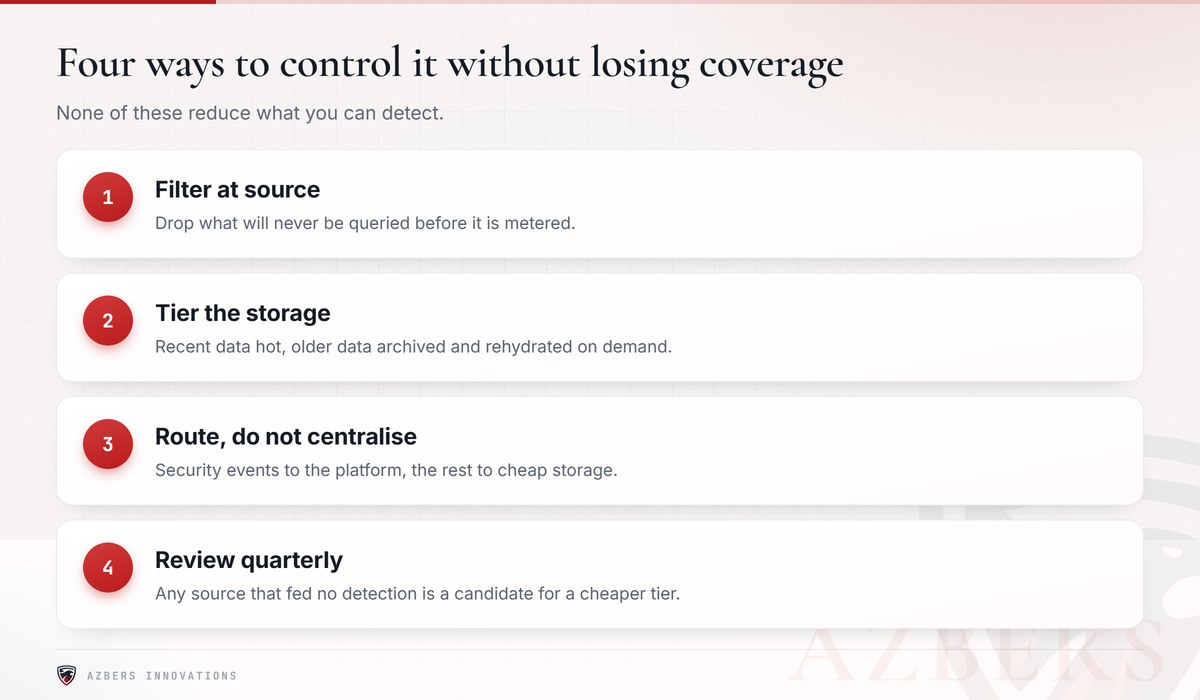
Four ways to control it that do not reduce coverage
Filter at source, tier the storage, route rather than centralise, and review sources quarterly.
Filter at the source. Drop what will never be queried before it is charged for. Health checks, successful routine polling, debug output left on by accident. This alone frequently removes a meaningful share of volume.
Tier your storage. Recent data hot and searchable, older data in cheap archival storage that can be rehydrated when an investigation needs it. Most investigations touch recent data. Compliance retention almost never needs to be instantly searchable, and the pricing difference between the tiers is large.
Route rather than centralise everything. A pipeline that sends security relevant events to the SIEM and everything else to cheap storage keeps the search capability where the value is. This has become standard practice for a reason.
Review sources quarterly. Ask what each source has contributed to a detection or an investigation. Sources that have contributed to neither in a year are candidates for a cheaper tier. Without this review the estate only ever grows.
When managed makes more sense
For organisations that cannot staff detection engineering and a rota, a managed service is frequently the cheaper honest answer, not the lazy one.
The trade is real and worth stating plainly. You gain coverage and expertise you could not hire. You give up some context, because an external analyst does not know that a given server behaves oddly for a legitimate reason, and you take on a dependency that is awkward to unwind.
The arrangement that works best in our experience is a split. The provider covers monitoring and first line triage, particularly overnight. Investigation and decision making stay in house, where the context lives. That keeps the judgement with people who understand the business and puts the rota burden somewhere it can be absorbed.
What does not work is treating a managed service as a way to avoid having any internal capability. Somebody has to be able to receive an escalation and decide something.
Questions to ask before signing
What exactly is metered, and is it raw ingested volume or something after processing. How does pricing behave if volume doubles. What does retention cost at each tier and how long does rehydration take. Can we filter and route before data reaches the meter. What does it cost to export our historical data if we leave. And who writes the detections, us or you.
That last question decides whether the platform arrives with capability or with a blank canvas and a deadline.
Where we stand
We think most organisations buy a SIEM a year before they should, and buy more of it than they need.
The order that works is to know your estate, prioritise your log sources, define your detections and responses, and then specify a purchase against known volume and known use cases. Doing it the other way round means the vendor's sizing assumptions become your budget, and their assumptions are not conservative.
We also think the staffing line belongs in the business case from the start. A platform nobody has time to tune is a subscription to unread alerts, and the person who eventually points that out will be blamed for the purchase rather than for the plan.
Our SOC design and monitoring practice does the source prioritisation and detection engineering that decides whether the platform earns its cost, and SOC Command covers the operating side for organisations that need capability without the rota. Threat Intelligence Mapper exists to keep detection effort aimed at what is actually being used against your sector rather than at everything.
Start here
Take your top five log sources by volume. For each, find one detection or one investigation from the last year that used it.
Any source where you cannot is a source you are paying premium storage for out of habit.
Common questions
What drives SIEM cost
Data ingestion volume is the primary driver in most pricing models, followed by retention tier and duration. Staffing for detection engineering and analysis usually exceeds both and is frequently left out of the business case.
Why did our SIEM bill increase without us buying anything
Volume grows on its own as applications are added, verbose logging is enabled for troubleshooting and left on, and cloud usage increases. Pricing keyed to volume rises accordingly without any purchasing decision.
How can we reduce SIEM costs without losing coverage
Filter unqueried data before it is metered, tier storage so only recent data sits in expensive searchable tiers, route non security data to cheap storage, and review each source quarterly against what it has actually contributed.
Is a managed SIEM cheaper than running your own
Often, for organisations that cannot staff detection engineering and a full rota. The trade is reduced environmental context and a dependency that is awkward to unwind. A common middle path is managed monitoring with investigation kept in house.
What should we ask a SIEM vendor about pricing
What exactly is metered and at what point in the pipeline, how cost behaves if volume doubles, retention pricing per tier and rehydration time, whether you can filter before the meter, the cost of exporting historical data on exit, and who writes the detections.