You implemented the control once. Why are you evidencing it ten times?
Multi framework compliance multiplies paperwork rather than security. The control never changed between regimes, and treating that overlap as real is the difference between a manageable year and an impossible one.
Azhar Ghafoor24 July 20265 min read
Somewhere in your organisation there is a person who has explained your access control arrangements four times this year. Once for the national standard, once for the international certification, once for a sector regulator, and once for a customer who sent a security questionnaire with two hundred and forty rows in it.
The access control itself did not change between any of those four occasions. The same directory, the same policy, the same review cadence, the same people. What changed was the wording of the question and the format of the answer.
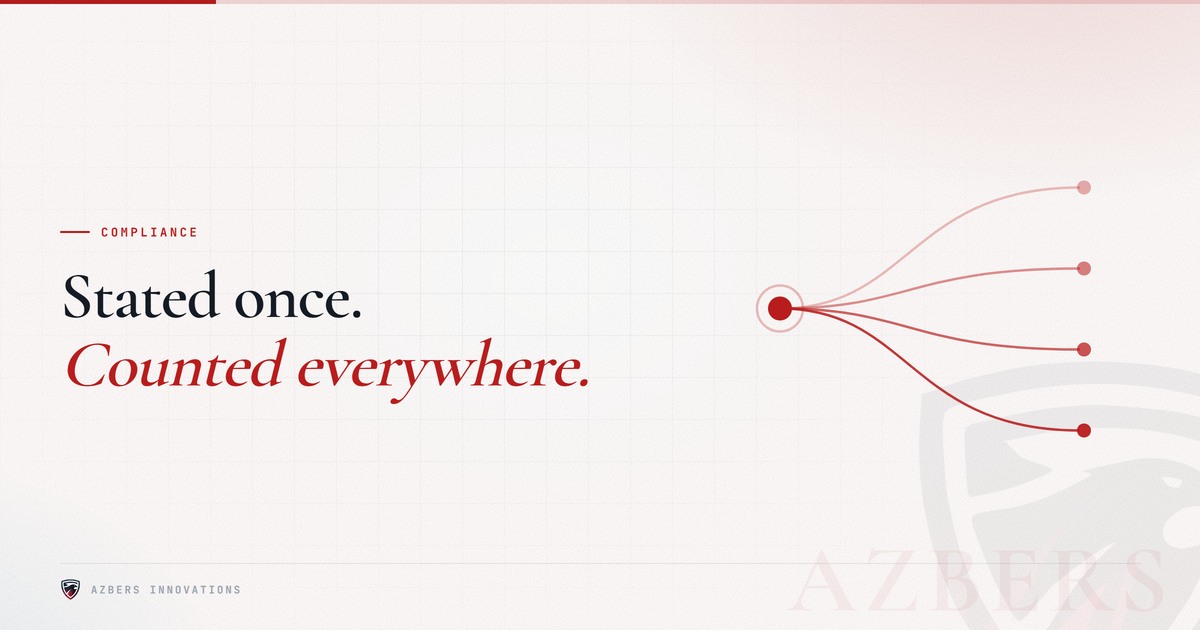
Stated once, answered everywhere
That person is not producing security. They are producing translations.
The arithmetic gets bad quickly
With one framework, the overhead is tolerable and mostly invisible. It looks like the cost of doing business, and it is.
With two frameworks, most teams handle the overlap informally. Somebody remembers that the answer to clause 9.2 is roughly the answer to the other framework's section on logical access, and they copy it across with light editing.
With three or more, the informal approach collapses. Not because the work is conceptually harder, but because the copies drift. Each one gets updated on its own schedule, by whoever happened to be handling that particular submission, and after a year or two the four descriptions of one control genuinely disagree with each other.
At that point you have something worse than inefficiency. You have four documents making different claims about the same reality, and no way of knowing which one an auditor will read.
The risk in multi framework compliance is not the effort. It is that the copies quietly stop agreeing, and the version being audited is rarely the version that is true.
What overlap actually looks like
It is worth being precise here, because the argument gets overstated in both directions.
The overlap between mature frameworks is genuinely large. Access control, change management, logging, backup, incident response and supplier management appear in some form almost everywhere, and the underlying expectation is usually close to identical. When the control is the same, the evidence for it is the same, and the work of proving it twice is pure waste.
The overlap is not total. Frameworks differ in scope, in the depth they expect, and in the specific things they care about. A national framework may require data residency conditions that an international standard says nothing about. A sector regulator may demand a reporting timeline that nobody else does. Those differences are real and pretending otherwise is how organisations end up non compliant while feeling efficient.
The useful model is therefore not one of equivalence but of mapping. One control, stated once, linked to every obligation it satisfies, with the obligations that need something extra clearly marked as needing something extra.
What changes when the mapping is structural
Once the relationship between a control and its obligations is recorded rather than remembered, several things stop being projects.
A new framework becomes a mapping exercise. You are no longer assessing from scratch. You are asking which existing controls already answer these new obligations, and what genuinely remains.
Evidence updates propagate. When the annual access review is completed, that evidence attaches to the control, and every obligation depending on that control is current in the same moment. No copies, so no drift.
Gaps become honest. Anything that is not linked to a control is visibly unanswered, rather than hidden inside a document that reads as though it was covered.
The question of who owns what becomes answerable. One control, one owner, however many regimes are relying on it.
The objection worth taking seriously
The reasonable objection to all of this is that mapping is itself work, and that a badly built mapping is dangerous because it creates false confidence. If a control is linked to an obligation it does not actually satisfy, you will believe you are covered when you are not.
That objection is correct, and it is the reason the mapping has to be reviewable rather than automatic. A suggested link is useful. A link that was applied without a person confirming it is a liability, and any system that blurs the two is selling convenience at the cost of the thing you were buying it for.
This is the constraint we build to in ControlGraph. The structure holds the relationships and can propose them. A person decides whether each one is real, and that decision is recorded along with who made it.
Where to start
You do not need a platform to begin. You need a list of every regime you answer to, and an honest count of how many times the same control has been described across them.
For most organisations of any size, that number is uncomfortable enough on its own to justify the conversation. If yours is, we would be glad to have it with you.
Common questions
How much do compliance frameworks overlap
Substantially. Access control, change management, logging, backup, incident response and supplier management appear in some form almost everywhere, and the underlying expectation is usually close to identical. The overlap is not total, which is why mapping matters more than assuming equivalence.
What is control mapping
Stating a control once and linking it to every obligation it satisfies, so evidence attached to that control answers all of them at the same moment. A new framework then becomes a mapping exercise rather than another full assessment.
Can control mapping be automated
Suggestion can be. Confirmation should not be. A link applied without a person agreeing to it is how an organisation ends up confident about coverage it does not actually have, which is worse than knowing the gap exists.
Why do compliance answers drift apart
Because copies are maintained independently. When the same fact lives in four documents updated on four schedules by four people, three of them go stale, and the version an auditor reads is rarely the one that reflects the environment.