Let AI propose your control mappings, but never let it approve them
Mapping a new framework, such as ISO 42001 or the NIST AI RMF, to the controls you already run is slow work that AI can genuinely speed up. The risk is treating a confident suggestion as a decision. How to use AI proposals with their reasoning attached, keep them out of every coverage figure until a person approves them, and record what has no counterpart at all.
Azhar Ghafoor17 February 20275 min read
In short
AI can propose a mapping and the reasoning behind it far faster than a person can read two frameworks side by side
A proposal should carry its reasoning, relationship type, confidence and the model that produced it
Pending proposals must count in no coverage figure until a named person approves them
Controls with no sensible counterpart should be recorded as assessed with a reason, not forced into a match
Every new framework arrives with the same question. How much of this do we already do? ISO/IEC 42001 for AI management systems, the NIST AI Risk Management Framework, a new national regulation. Answering means reading the new document control by control and deciding, for each one, which of your existing controls covers it, partly covers it or does not cover it at all.
It is exactly the kind of work AI should help with. It is also exactly the kind of work where an unexamined AI answer can mislead an auditor, a regulator and your own board at once. The rule we work to is simple. AI proposes. A person decides.
What a good proposal looks like
A bare pair of control codes is not a proposal anyone can review. A useful one says how the two controls relate, using a fixed vocabulary. Equivalent, where the new control is fully covered. Partial, where some of it is covered, with the missing part stated. Related, where they touch the same area without one covering the other. It gives the reasoning in a sentence or two, a confidence, and a record of which model and which version of the instructions produced it.
With that, a reviewer can agree or disagree in seconds rather than repeating the analysis from scratch. Without it, the reviewer either rubber stamps or starts over, and neither is a good use of the time AI was supposed to save.
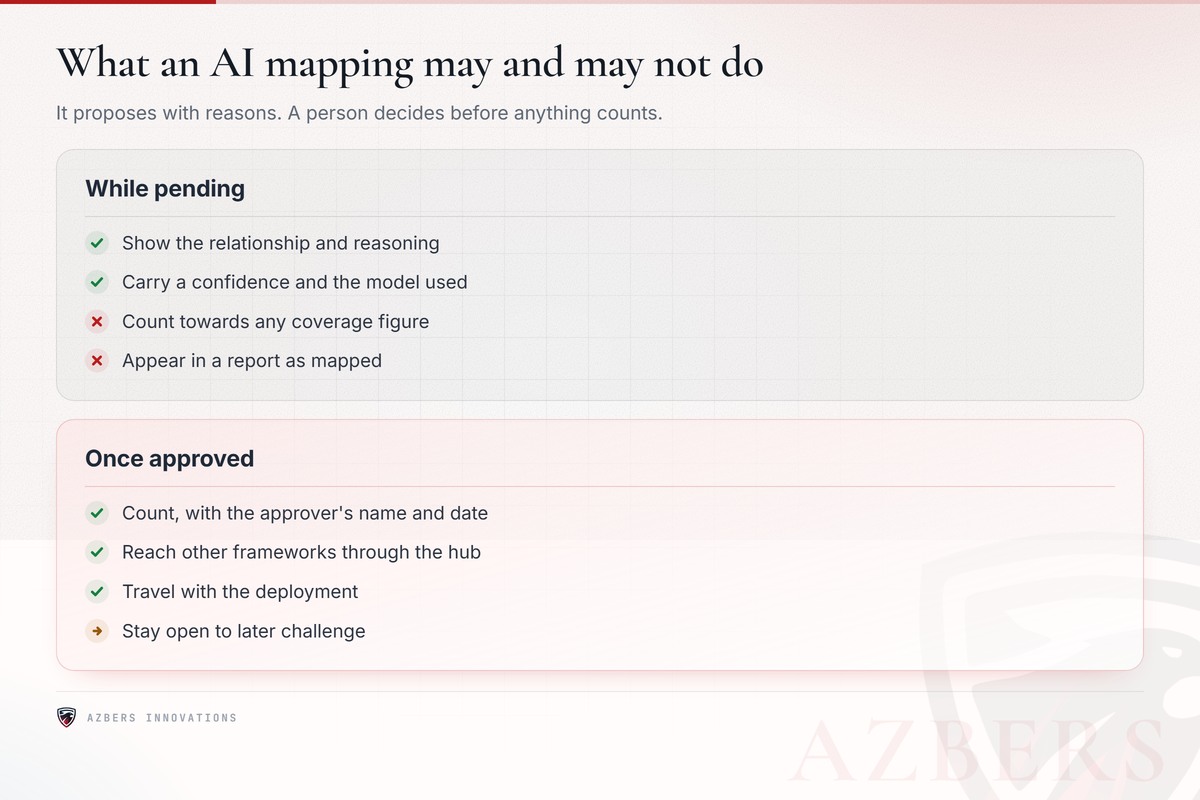
An AI proposal carries the relationship, reasoning, confidence and model. It stays pending and outside every coverage figure until a person approves or rejects it.
Pending means it does not count
The most important design decision is what a pending proposal is allowed to do. Our answer is nothing. It does not count towards coverage, it does not appear in a report as mapped, and it cannot be cited as evidence that a requirement is met. Only when a named person approves it does it become part of the organisation's record, with their name and the date attached.
This matters because coverage figures travel. A dashboard showing strong alignment with a new framework will be quoted in a board paper long after anyone remembers that most of it was machine suggested and unreviewed. We set out the wider argument in who approved this mapping, and it applies with more force when the mapping was generated in bulk.
Some controls have no match, and that is an answer
Not every control in a new framework has a counterpart. Headings, definitions, penalty clauses and provisions about how a regulator itself is organised do not map to anything an organisation operates. An AI asked to find a match for everything will find one anyway, and it will be wrong.
The honest record is "assessed, no mapping", with the reason. That stops the same controls being sent back for mapping again, and it stops them being counted as either covered or uncovered when they are neither.
Map once to a hub, not to everything
There is also a choice about what to map to. Mapping a new framework separately to every other framework you follow multiplies the work. Mapping it once to a broad, well connected reference set lets every approved link through that set reach the others. ControlGraph uses the Secure Controls Framework this way, because it already connects to more frameworks than any other set in the catalogue.
How we built it into ControlGraph
ControlGraph now holds AI proposed mappings for frameworks no published crosswalk covered, starting with Pakistan's own instruments and then international standards including ISO/IEC 42001, ISO/IEC 27001 and the NIST AI RMF. Every proposal records its relationship type, reasoning, confidence, model and prompt version, and stays Pending Review, counting in no coverage figure, until a ControlGraph administrator approves it. Controls with no sensible counterpart are recorded as assessed, with the reason.
ControlGraph
Demo environment, sample dataAzbersInnovations
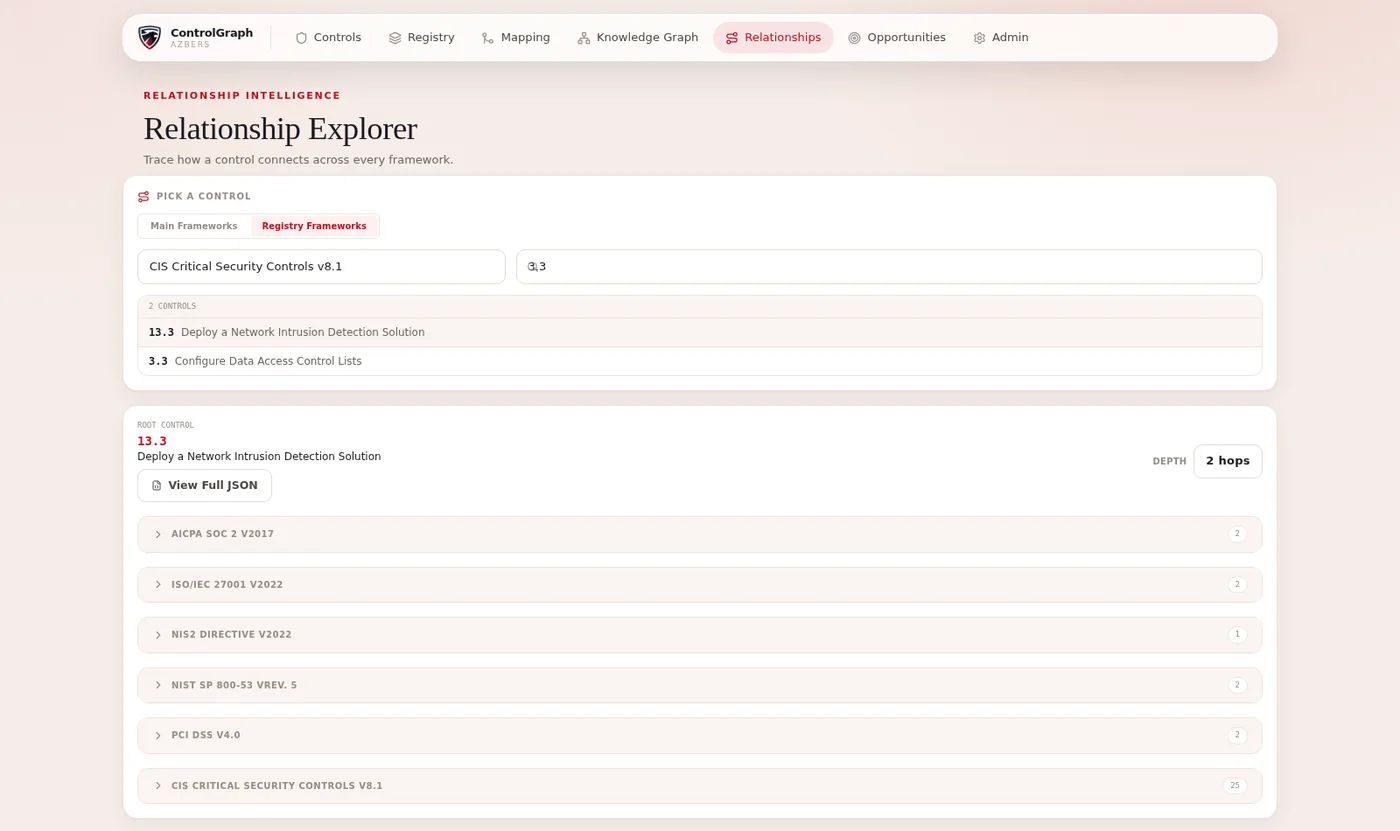
The relationship explorer in ControlGraph, listing one control's related controls by framework with the source and approver of each relationship. Sample data.
The proposals and the decisions on them are kept in files that travel with each deployment, so a review done once is not lost when a system is rebuilt.
Start here
Decide which new framework you need to understand, and which reference set you will map it to.
Let AI propose mappings, but require reasoning, a relationship type and a confidence on each.
Keep every proposal out of your coverage figures until a named person approves it.
Record controls with no counterpart as assessed, with the reason.
Review the lowest confidence proposals first, where human judgement adds the most.
If you are working out what a new AI governance framework means for your existing controls, our GRC service can run the first mapping with you.
Common questions
Can AI map compliance frameworks accurately
AI can propose mappings quickly and often well, especially when it states the relationship and its reasoning. It still makes confident mistakes, so every proposal should be reviewed and approved by a person before it is relied on.
Should AI generated mappings count towards compliance coverage
No. A pending AI proposal should count in no coverage figure or report until a named person approves it, because coverage figures are quoted long after anyone remembers how they were produced.
What should a reviewer see in an AI mapping proposal
The relationship type, such as equivalent, partial or related, the reasoning, any missing coverage for partial matches, a confidence, and which model and instructions produced it.
How do you map ISO 42001 or the NIST AI RMF to existing controls
List the framework's controls, map each to a broad reference set your other frameworks already connect to, classify each relationship with its reasoning, have a person approve each mapping, and record controls with no counterpart as assessed with a reason.